Change Management for AI Agent Deployment in Manufacturing Plants
AI agent deployment in manufacturing plants is a change in who does the work and who holds the authority to decide. For it to succeed, human roles, decision rights, and workflows must be rebuilt before the agent goes live. A working pilot proves that an agent can perform a task.
Why AI agent rollouts in manufacturing plants stall between pilot and production
A procurement manager arrives on Monday morning to find that an agent has already contacted a supplier, adjusted a production schedule, and notified stakeholders. The manager must now judge the decisions already made and decide whether to step in.
A copilot answers when asked, while an agent acts on triggers, opens work orders, reroutes suppliers, and escalates on low confidence. The shift changes the human-machine contract because work proceeds without a person initiating each step. Yet a successful technical proof of concept is routinely mistaken for readiness to accept that contract. The finding that 80% of manufacturing AI pilots stall before reaching production points to the scale of the gap.
Dataiku's 2026 manufacturing trends analysis identifies “pilot purgatory” as the defining failure mode separating early adopters from laggards. Controlled tests on extracted data do not expose everything an agent will encounter in live ERP, MES, and SCADA systems. Inconsistent APIs and siloed data warehouses change the conditions under which it acts. Production therefore tests both the integration and the organization expected to govern it.
What an AI agent actually changes on the plant floor — and what that demands of the people around it
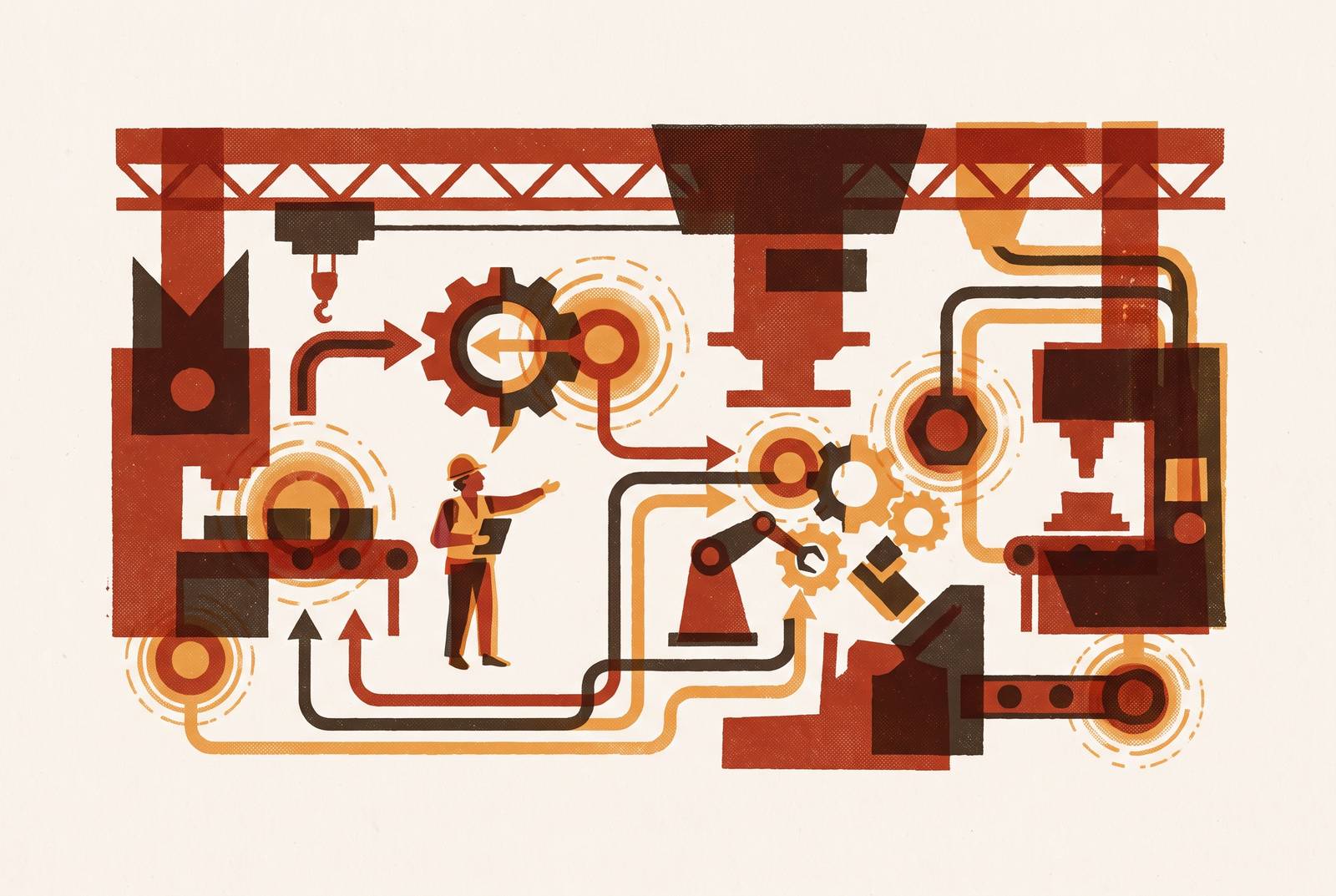
The unit of work an agent removes is a monitoring-and-response loop. Detection can lead through cross-referencing, work order creation, a parts check, and technician dispatch without a human handoff at every stage. A copilot saves time within that sequence. An agent can take the sequence out of human queues altogether, changing what the surrounding jobs are for.
Procurement managers who used to cut purchase orders by hand now audit decisions the agent has already made. That is a move from execution to exception handling and governance, with different demands on skill, authority, and accountability. The person responsible for a result may no longer be the person who initiated the action. Decision rights are redistributed through the workflow whether or not management has deliberately designed that redistribution.
Infor's 2026 analysis describes teams that step in when human judgment is needed, with the agent taking on routine decision-making. Their work can then shift from reactive monitoring to creative problem solving and continuous improvement. The historical parallel is the arrival of electricity in factories organized around steam engines. Its value depended on understanding the new layouts and roles it made possible, rather than merely using it to run the old arrangement faster. Agents create a similar distinction between accelerating work and reorganizing it.
Why treating AI agent deployment like a standard software rollout is the root cause of failure
Treating this redistribution as a standard software rollout is a category error. Training users to operate an ERP module or dashboard assumes that people retain their tasks and learn a different way to perform them. Deploying an agent changes which tasks people are still responsible for. The role must therefore be redesigned before people can be prepared to perform it.
Communication and training do not answer that design question. A team can understand the new system and still lack authority to reverse an agent's decision or responsibility for reviewing its exceptions. Infor's 2026 industry analysis identifies mindset as the biggest barrier to delegating decisions to autonomous systems. But willingness to delegate cannot substitute for an explicit account of what is being delegated and where human control resumes.
Dataiku's 2026 analysis distinguishes early adopters that pair deployment with process optimization from organizations that treat agents as a technology overlay. Layering an agent onto a broken process produces a faster broken process. Clean pilot data can hide the weakness, while running the process live gives it more chances to grow. The root error is postponing organizational design until after the technology has established how the work runs.
The specific failure modes that appear when change management gets the sequence wrong
The quietest failure is an agent producing outputs that nobody is structured to act on. Its test results may have been correct, and it may still appear operationally healthy. But the monitoring loop has been removed without an exception-handling protocol taking its place. Exceptions accumulate unreviewed because the deployment transferred execution without assigning the residual human work.
A second failure occurs when the pilot never tests the write-path. Reading extracted records is different from opening work orders, updating ERP records, or rerouting procurement in live systems. Decades of accumulated ERP configurations, inconsistent APIs, and siloed data can make production behavior diverge from the demonstration. Technical faults may be involved, but treating those conditions as a post-launch discovery is a scoping and readiness failure.
A procurement agent's failure can propagate to a production scheduling agent before a human intervenes. Without defined review responsibilities and escalation boundaries, local execution can outrun operational control. Monitoring critical control loops therefore calls for the organization to know how to oversee the work as well as check that the software is still online.
These gaps can also prevent a decisive launch or cancellation. Agentic AI proof-of-concept abandonment rates in manufacturing reach as high as 46% before production. Other deployments remain indefinitely in supervised, limited operation. They consume resources without eliminating the monitoring-and-response loop that justified the investment.
What the manufacturing plants that reach production actually do differently before deployment begins
Dataiku's 2026 manufacturing analysis identifies a more deliberate route into production. It starts with high-value, non-production-critical processes, requires human validation for financial or safety-critical actions, and connects agents to documents, operational databases, and APIs. These choices establish the scope and boundaries of delegation before live execution.
Daikin Industries worked with Hitachi to build an AI agent that helps with equipment fault diagnosis on the factory floor. Trial operations began in April 2025, with practical use as the explicit target before expansion to production sites in Japan and overseas. The case grounds deployment in a specific operational problem and a structured trial. It does not require treating a successful demonstration as evidence that every production condition has been resolved.
Lenovo embedded iChain at the core of its global supply chain rather than placing it above operations as a reporting layer. The platform coordinates specialized agents within the supply chain workflow. Infor's 2026 analysis shows why it matters more broadly to remove data silos and connect factory floor machines with supply networks and logistics systems. In that setting, predicted inventory shortfalls can trigger replenishment and production plans can adapt in real time. Workflow and integration must be established as foundations before the agent is running.
How to sequence the organizational redesign — role by role, process by process — before an agent goes live
Start with a process audit before choosing the agent architecture. Ask the people who run the target process to show how it actually works, including informal decisions and workarounds absent from SOPs. Identify where information is siloed and where the human workflow breaks. The output should be a decision map showing what each person decides, how quickly, on what information, and with what authority. That map defines what the agent will take over and what it must escalate.
Next, define the human roles that remain after that transfer. Set out whether each person will be an exception handler, governance auditor, or escalation reviewer, then hire people or build their skills for that work before deployment. Plant managers and finance directors overseeing autonomous procurement or predictive maintenance need job descriptions that reflect those responsibilities. Training follows the role definition because people cannot prepare for a job that has not been designed.
Then build the governance framework as the agent is developed, with its rules settled before live action. Define approval thresholds, escalation triggers, and audit trails. Require human validation for financial or safety-critical actions, and name who reviews performance and on what cadence.
Before connecting live systems, assess and remediate master data for the assets, parts, and customers the agent depends on. Cover the ERP, MES, and CRM systems it must read and write. Test the write-path against live system behavior. This gate addresses both the conditions under which the agent will act and the quality of its reasoning.
Finally, put one troublesome process with clear limits into live use before scaling up. Choose high-friction, data-rich work, such as root cause analysis for quality issues or spare parts procurement, rather than starting with a production-critical process. Use that deployment to check whether the redesigned roles, decision rights, and governance work in real conditions. The first live process is a test of the operating model as much as the agent.
Where quality and supply chain functions are actually succeeding with agents in 2026 — and what the shop floor can take from those patterns
Quality and production are among manufacturing's most advanced areas of agent adoption in 2026. The important distinction is between flagging an anomaly and closing the loop through disposition, root-cause categorization, and containment initiation. Removing handoffs changes how the work gets done as well as how well one part of it is analyzed.
Siemens Senseye deployments have reported reductions in unplanned downtime and lower maintenance costs through a shift from reactive fault response toward a continuous detection-to-action loop. Panasonic Connect reduced drawing-verification work from hours to minutes, an 80–97% reduction, by replacing the manual handoff sequence. These outcomes concern specific work with a defined operational purpose. They provide stronger grounds for judging deployment value than a broad claim that a plant has adopted AI.
Lenovo's iChain platform keeps track of demand, supplier constraints, and transport flows in real time. Because it helps coordinate the global supply chain from within, it can act in the workflow without people having to turn separate reports into decisions. Lenovo reported a 30% improvement in shipment accuracy. The transferable pattern is a bounded process organized around execution, with human responsibilities and escalation thresholds defined before live connection.
That evidence does not establish readiness for every kind of plant autonomy. Fully autonomous production scheduling and closed-loop process control on safety-rated systems are still at the pilot stage as of 2026. Vendor claims in those areas need a close look because there is still no production-scale field evidence at that level. Success in a defined quality or coordination process is not proof of safe autonomy across the plant.
What operations leaders should demand from any AI agent deployment before it touches the plant floor
Operations leaders should require evidence of readiness. The first evidence is a documented process audit showing how the work runs today and where it breaks. The second is a set of redesigned roles showing who does what after delegation and what authority each person holds. Preparation for those roles must precede go-live.
The governance framework should state what the agent may do autonomously, what needs approval, and what triggers escalation. It should also name the people responsible for reviewing performance and establish their review cadence. The data readiness assessment should identify the systems the agent reads and writes, the condition of live master data, and the gaps closed before connection.
The final demand is a specific first process, with a clear reason for its selection and a credible date for live operation. A platform roadmap or transformation vision does not answer that demand. The right deployment partner starts with where the process breaks and rebuilds from there, targeting a live first process in weeks. Speed matters only when the prerequisite work is complete. The standard for release is safe, legible, reversible delegation.