Field Evidence vs. Declared Plans in Operational Risk Assessment
Auditing only declared plans leaves your biggest operational risks invisible until something breaks.
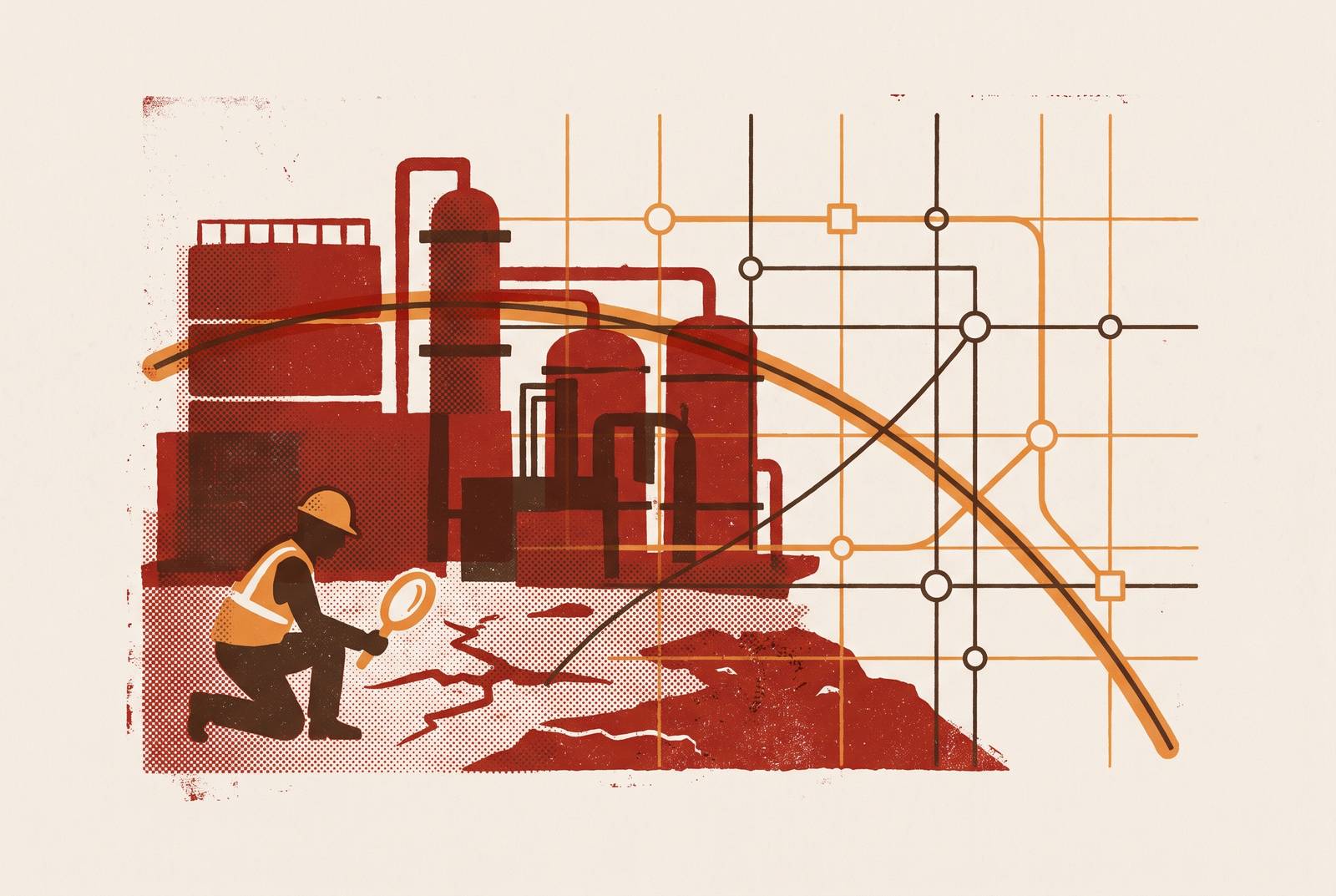
A construction build site runs on a schedule that says framing finishes Tuesday, inspection happens Wednesday, and drywall starts Thursday. The schedule still says what it always said, and by Thursday it looks accurate, but it was never describing what actually happened. It was describing what someone intended to happen before the lumber truck was late. That gap between intention and execution is a structural feature of how schedules, standard operating procedures, process maps, and transformation roadmaps get written in the first place: they capture the designed path, not the path people take once that design meets a late delivery, a sick crew member, or a shortcut that works better than the manual says. Every real workflow has three layers sitting on top of each other. There is the actual process, which is what workers do once friction and exceptions enter the picture, including whatever shadow workflows and informal fixes they build to keep output moving. And there is the data trail, which is what the system of record logs, and which may not match either of the other two. Auditing only the first layer leaves the other two invisible, so the biggest sources of operational risk never surface until something breaks badly enough to force a look. A large share of the market is declaring transformation while the actual process substrate stays exactly as it was.
What field evidence captures that a plan cannot
Field evidence is the record of where work actually breaks down, and it takes a specific, countable form: cycle times at each step, exception logs showing when someone abandoned the documented path, SLA breaches marking where handoffs failed, ownership gaps where no one person is accountable, and manual overrides where automation got quietly bypassed because it didn't work for a real case. None of these appear in a declared plan, because a plan is written before the work happens and field evidence only exists after it. A real process audit has to make all three workflow layers visible at once: the designed process, the actual process, and the recorded data trail. Risk concentrates in the gap between any two of them, not in any single layer viewed alone. This is a different kind of measurement than an adoption metric. Deloitte's 2026 report draws a line between organizations optimizing their existing processes with AI and organizations actually reimagining how their business runs, and finds only 34% fall into the second group. An adoption number tells you how many people touched a new tool. The distinction matters most under stress: a process that looks compliant on paper but runs on workarounds will hold fine until the moment it's actually tested, and that's the exact moment you needed it to work. None of this evidence collects itself, and none of it gets acted on until someone names what to look for and goes and gets it.
The plan-vs.-reality gap as an acute AI failure mode
Introducing AI into a workflow does not close the gap between what a company says it does and what it actually does. An AI system inherits the process it's handed rather than correcting it, so it widens whatever gap was already there, for better or worse. Most AI agents that fail are failing on workflow design and data quality, not because the underlying model lacks the capability to do the job. The clearest version of this failure pattern: a process that cannot be described and documented in plain terms cannot be executed reliably by an agent. Standardization has to come before automation. Feeding poor data into an AI-driven workflow doesn't simply cap performance at some lower level. It produces confidently wrong output at scale, so bad automation often costs more than no automation. That is the operational stance behind Terminal Use's work: automating a broken process doesn't fix it, it just breaks things faster. Deloitte's 2026 report finds only one in five companies has a mature governance model for autonomous agents; most companies that deploy agents have no reliable way to catch what those agents get wrong once they're running. Gartner's research captures the same tension from the other direction: 40% of enterprise applications are projected to carry task-specific AI agents by the end of 2026, while more than 40% of agentic AI projects are projected to be canceled by 2027 over rising costs, unclear business value, and weak risk controls. Production surfaces failure modes that no demo ever showed, because a demo runs on clean, curated data and production runs on whatever the real process actually produces.
Where construction schedules and procurement records diverge most dangerously
A construction schedule built in P6 or an equivalent tool records intent: what the project plans to do and when. It says nothing about whether the procurement decisions, coordination handoffs, and commissioning sequence needed to make that intent real are actually in place. The signals that would tell you otherwise live elsewhere. AI pilots in construction tend to fail for the same underlying reason. The labor shortage in the industry, more than 500,000 open positions in the U.S., makes this worse rather than better, because the people who would normally catch a coordination failure before it compounds simply aren't there in sufficient numbers. The AI system meant to catch what they'd have caught is working from the same declared-plan data everyone else is working from, and it misses the same things a shorthanded team misses. Terminal Use's operational approach starts by mapping these three layers directly: the designed schedule, the actual sequence of work, and what the procurement and commissioning records show happened. Contract language often lags behind the AI tools a project is actually using, and on complex jobs, the absence of clear terms for how AI-driven recommendations get treated when something goes wrong can turn into a dispute on its own. Declaring a commissioning milestone on track when the procurement and coordination data says otherwise ranks among the costliest mistakes a project team can make, because by the time the gap becomes visible, there's little runway left to close it.
Manufacturing's AI rollout reveals the same pattern at the process level
Manufacturing shows the same structural gap in a different shape: the distance between how many AI pilots a company has running and how many of those pilots have actually scaled. Deloitte's AI in Manufacturing survey of more than 140 manufacturers found that while most, 84%, report measurable value from AI, only about one in five use cases has been scaled consistently across sites or across the enterprise. Where AI adoption actually concentrates tells its own story. Quality is 62%, Production is 57%, and Logistics and Supply Chain is 49% because these are the areas where process signals are dense, outcomes are easy to measure, and someone clearly owns the result. IDC's 2026 Manufacturing Industry FutureScape projects that by 2026, over 40% of manufacturers with a production scheduling system already in place will upgrade it with AI-driven capabilities aimed at enabling autonomous processes. It's a gap that a large share of the manufacturing base is already living inside, between what their production scheduling systems are declared to do and what they can actually do without a human catching the edge cases.
Logistics and retail expose the gap through integration debt and workflow governance failures
In logistics and retail, declared AI capability routinely runs ahead of the workflow governance needed to support it. The integration debt, chain-of-custody gaps, and eligibility rules an AI system needs to operate cleanly are operational plumbing, so they almost never appear in a vendor's roadmap or a company's stated deployment plan. Where this data is incomplete, a declared AI capability simply doesn't work in practice, regardless of what the pilot deck claimed. The cases where this evidence layer was clean enough show what's achievable. Hormel rolled out AI-driven planning across more than 70 dry and refrigerated sites, a deployment that required the actual process at each site, not the one described in a corporate rollout plan, to be auditable node by node. Most supply chain organizations aren't there yet. Only a small minority are pursuing immediate AI-led workflow redesign; most are still running AI-generated recommendations through workflows a human has to approve at every step. That's its own version of the declared-versus-actual gap: the plan says AI is driving the process, and the execution says a person is still signing off on each decision the AI makes. The lesson from these cases is that wherever the evidence layer, the SKU data, the custody records, the eligibility rules, is clean, AI scales, and wherever it isn't, the declared plan and the operational reality keep drifting apart no matter how good the roadmap looks.
The objection that moving fast makes field-evidence auditing obsolete
The strongest counterargument to all of this says that auditing field evidence before deploying AI is a luxury companies competing for market position can't afford, and that speed itself is the strategy. Companies are clearly scaling ahead of process maturity rather than waiting to achieve it first, and in a market moving this fast, that looks like the rational bet. But the same period that produced those adoption numbers also produced the failure numbers. Fewer than one in eight AI agent initiatives reach production operation, and Gartner projects more than 40% of agentic AI projects will be canceled by 2027. The answer is to audit the specific process a company is about to automate, before automating it, and nothing more, rather than auditing every process in the company before touching any of them, which would just trade one kind of paralysis for another. Terminal Use's approach reflects that scope: bring a specific, painful process, show exactly how it runs today and where it breaks, and only then decide what gets rebuilt. That structure is built to make field-evidence auditing fast, not indefinite. The governance maturity numbers back up why this works. About one in eight organizations have reached the state where AI runs a process end to end and humans audit the outcomes along the way. The organizations that get there typically start with low-stakes, reversible automation, measure its performance rigorously, and widen its scope only once reliability has actually been proven. That's field-evidence-first deployment, not slow deployment, and the distinction is the whole argument.
A practical framework for collecting field evidence before and during AI deployment
Collecting field evidence before deploying AI is a structured process of exposing a workflow that's already running, and the evidence needed to do it already exists inside any operation that's been running long enough to have accumulated exceptions. The first step is a process walk: ask the people who actually run the process to show exactly how it works today, including every point where they deviate from the documented procedure. One question works as a sharp diagnostic on its own: can this process be described and documented clearly? If the answer is no, an AI agent has no reliable way to execute it, and the inability to produce a clear description is itself evidence that the process isn't ready for automation. Standardization has to happen before deployment, not after. The right place to start is the process that's most painful, most frequent, and most visibly broken, because that pain is itself evidence of how far the designed and actual workflows have drifted apart. Terminal Use's process audit puts this into practice directly: a client shows exactly how a process runs today and where it hurts, and only after that does anyone decide what to rebuild, a sequence applied the same way across construction, logistics, manufacturing, and retail clients. Good field evidence also tells a company where to point AI first: at the process areas where data is densest and outcomes are easiest to measure, which lines up with what Deloitte's manufacturing survey found separates the organizations that actually scale AI from the ones that stall at pilot stage. And the discipline doesn't end once a system goes live. The same governance path applies afterward: start with automation that's reversible and low-stakes, measure its performance against the field-evidence baseline gathered before launch, and expand its scope only as reliability gets proven in production, not as it was promised in the original plan.
Ground truth for operations leaders when declared plans and field evidence diverge
When a declared plan and the field evidence disagree, the evidence wins, because a plan is structurally unable to capture the exceptions, workarounds, and coordination failures where operational risk actually accumulates. Treat any declared readiness claim, a schedule milestone, a stage on a transformation roadmap, a stated AI deployment status, as a hypothesis that still needs testing against field evidence, never as a settled fact. Roughly one in eight organizations have already reached the state worth working toward, where AI runs a process end to end and humans audit the outcomes. That state is only reachable through the field-evidence discipline described above, because no one can govern a process they haven't actually measured while it's running in production. By 2026, enough companies have run enough AI projects into production, and watched enough of them get canceled, that this argument no longer rests on theory. The record of what actually happened when AI met undocumented process is itself now a body of field evidence, and it says the same thing the construction schedules and procurement logs have been saying all along.