Why Workflow Documentation Is Not the Same as Workflow Reality
Documented processes rarely match how work actually happens in practice.
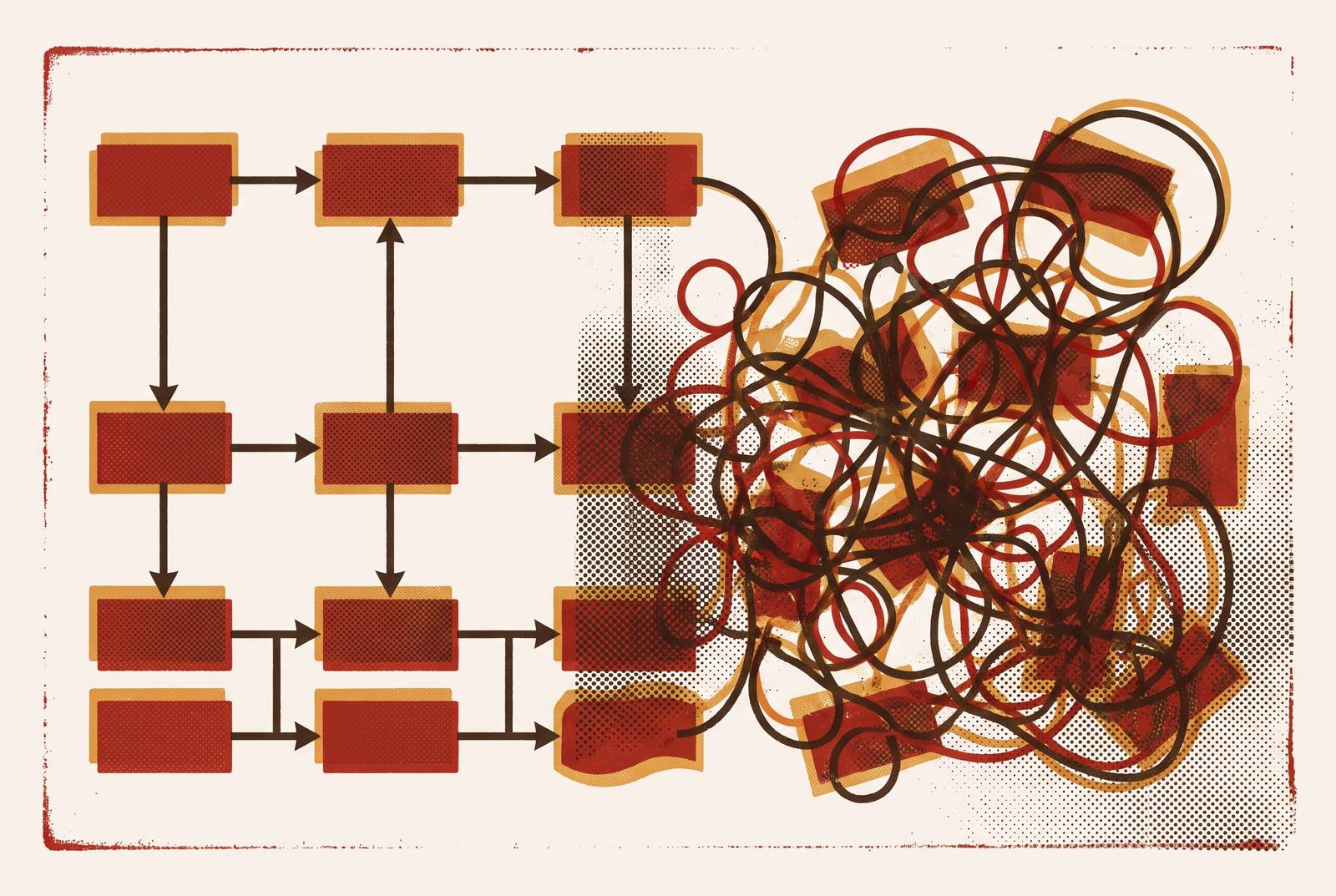
An approval sits in the standard operating procedure as a required step. In practice, it gets skipped three times out of five, because the person who used to sign off left the company eighteen months ago and nobody updated the flowchart. A handoff that the documentation routes through the ERP system actually happens over Slack, because the system field never matched what the receiving team needed. These are not edge cases. They are the normal condition of enterprise operations, and they point to a structural fact: workflow documentation captures the process a team intended to build, not the process it actually runs.
Why workflow documentation drifts from operational reality
The divergence between what is written down and what actually happens is a function of timing and intent, and both work against documentation staying accurate for very long.
Consider timing first. The moment a process gets documented is never the moment it gets executed, and the two moments pull apart almost immediately. Documentation rarely keeps pace with any of this. Employees do not wait for someone to reconcile all of that. None of this reflects carelessness. It reflects the fact that the documented version has already stopped matching the environment it was written to describe.
A second mechanism works alongside the first, and it is subtler because it has nothing to do with the passage of time. Teams often document the process they wish they had, not the one they actually operate. A broken invoice queue, a messy KYC intake process, or a contract approval loop with hidden side paths needs to be cleaned up before any software touches it, because automating the idealized policy version locks the gap between policy and reality into place.
That gap produces concrete operational damage. Approvals get skipped or, just as often, doubled by two people who each think they are the one responsible. Exceptions accumulate instead of getting resolved, and manual workarounds spring up at the seams between systems that were never built to talk to each other. Every one of these is invisible to anyone reading the documentation alone.
What the gap looks like when a process is mapped against reality
When the real process is mapped against the documented one, the result is frequently a different process altogether, one that shares a name with the documented version and little else.
Process mining is the discipline that turns this divergence into something measurable and demonstrable. Instead of asking a process owner to describe how a workflow runs, it reconstructs the actual sequence of steps, branching points, and bottlenecks directly from event logs, the digital trail a process leaves behind as it moves through ERP, CRM, and workflow systems. Applied consistently, process discovery reveals that the documented process and the actual process diverge significantly, and that divergence is sharpest in departments where employees have spent years developing informal workarounds that never made it into any written description. What these efforts surface, repeatedly, is a familiar set of symptoms: duplicate checks performed by two teams who don't know the other is also checking, manual re-keying of data that should have moved automatically between systems, approval loops that the written policy never mentions, and exception paths that have quietly become the de facto standard route for a meaningful share of volume.
A fulfillment process in retail e-commerce illustrates the pattern cleanly. On paper, the sequence is simple: receive the order, pick it, deliver it, invoice it. Interdepartmental friction and distribution-center overload accumulated at the seams between steps that looked fine individually, and none of that friction was visible anywhere in the documented version of the process.
The same pattern appears in finance. A team that finally maps its actual invoice process discovers that the workarounds holding the process together have become load-bearing: removing them without first understanding what they compensate for breaks the process further. Invoice extraction, bill of lading handling, and KYC onboarding all hide small variations, a slightly different document format here, a manual exception there, that look trivial individually but become major sources of error once volume scales and those variations repeat thousands of times.
Why automating from documentation makes the gap dangerous
Automating the documented process does not close the gap between what is written and what actually happens. It locks that gap in place and accelerates every consequence that follows from it.
The mechanism is straightforward. Automation gets built against the process as described, which means the workarounds, informal approvals, and exception paths that are actually keeping the real process functional never get encoded into the system. Automating the idealized policy version preserves the distance between policy and reality rather than closing it, because the automation now runs with total consistency against a process description that was already wrong. Nobody can point to the one broken link, because the failure is distributed across a chain built on a faulty premise.
McDonald's drive-thru voice assistant pilot, built with IBM, is a field example of this dynamic playing out at consumer scale: the technology was shut off across all test restaurants no later than July 26, 2024, after the automated process failed to hold up against the full variation of real customer orders. Klarna offers a parallel case from a different industry. Klarna's answer was a hybrid model that puts people back into the parts of the process where the documented, automatable version had not actually matched what customers needed.
The organizational version of this failure is quieter but just as costly. Improvement projects built to fix problems described from memory, rather than measured with data, end up addressing the documented problem instead of the operational one. Compliance checks that compare documentation against documentation never reach actual behavior. Traditional documentation systems cannot keep pace with operational complexity, and by the time any documentation gets updated, the workflow it describes has often already changed again.
How the gap compounds in asset-heavy, sequentially dependent operations
In industries where process steps depend on one another in strict sequence and recovery options are limited once something slips, the documentation-reality gap stops being an efficiency problem and becomes a risk accumulation problem.
Schedule documentation, the kind built in tools like P6, captures intent at the moment of authorization rather than achievability over the life of the project. The documented schedule shows a single delivery date. The schedule's real process is a cascade of interdependencies that the schedule was never built to capture.
Infrastructure energization compounds the same dynamic through procurement. Transformer lead times averaged 120 weeks in 2024, a constraint that almost never appears in the project schedules drafted at authorization, when the procurement timeline still looked manageable. The recovery options that could have absorbed that constraint have usually already closed by the time it surfaces in the project.
Logistics and manufacturing run on the same sequential dependency structure, which means an undocumented workaround at one node propagates downstream before anyone notices it. Process automation stalls in these operationally complex industries because the orchestration layer managing the automated steps has no way to account for exception paths that were never written down to begin with.
The structure is the same across all three industries. The documented process describes a linear sequence. The real process is a network of interdependencies and exception paths, and the gaps between the two accumulate quietly until a single constraint, a delayed utility connection, a missing transformer, a manual handoff error, triggers a cascade that the documentation gave nobody reason to anticipate.
Why AI deployments in these industries fail at the process design stage
The dominant failure mode in enterprise AI agent deployments has little to do with the capability of the models involved. It comes from building the agent against the documented process rather than the one actually running in production.
AI agents need a clearly describable, standardized process to execute against reliably, and the documentation-reality gap means the process description fed to the agent at design time is not the process the agent will actually encounter once it is live. Agents demo cleanly against the documented process, win budget approval on the strength of that demo, and then stall once they meet the informal workarounds, exception paths, and undocumented approvals that the real process has depended on for years.
This orchestration challenge is structural. Process automation stalls in these industries precisely because orchestration logic cannot account for exception paths nobody wrote down. Missing governance and permissions, zero observability into an agent's decision steps, and poor data readiness are downstream symptoms of a single root cause: the process the agent was built against was never the process actually running on the floor.
A further risk compounds this. Shadow processes, informal workflows operating in production that no process owner has ever recorded, run alongside the documented version in most organizations. When an agent operates against a process map that excludes these paths, its decisions are effectively ungoverned against a meaningful share of the actual workload it touches.
Some practitioners argue the documented process is good enough to start with, on the theory that agents can learn to handle variation once they're in production. The deployment record argues against this. An agent does not learn the real process from this failure. It amplifies the gap between the modeled process and the live one, at the speed and scale automation was built to provide.
What a process audit surfaces that documentation cannot
Closing the documentation-reality gap does not start with better documentation tools. It starts with a structured examination of how the process actually runs, conducted before any redesign or automation decision gets made.
A process audit is built to surface what documentation cannot. Documenting the live workflow in full, every handoff, every system, every exception path, and then separating policy from reality by comparing the approved process against what people actually do, is the starting discipline of this work, not an optional step ahead of the real project.
Process mining extends this audit into the data layer itself. Event logs pulled from ERP, CRM, and workflow platforms reconstruct the actual sequence of steps a process follows, rather than relying on what a process owner remembers or reports secondhand.
Terminal Use approaches this gap as the entry point to every engagement: rather than accept a client's documentation as a baseline, it begins with a process audit that forces the documented version into direct confrontation with how the process actually runs, because understanding the specific mechanisms that widen that gap is the precondition for rebuilding the workflow, not patching it.
The audit also determines what gets redesigned first. The right starting point for any AI-first process change is a specific, painful process with clear handoffs and measurable failure points, not a platform strategy or a sweeping transformation roadmap. The audit's real output is a decision about which process is worth redesigning and which is worth discarding, because automating a broken process only makes it break faster.
What rebuilding from the real process looks like
Organizations that genuinely close the documentation-reality gap do so by redesigning the process around how work actually runs, not by updating the SOP to match the workarounds and then automating that updated document.
The distinction between patching and rebuilding is the whole argument in miniature. AI systems need workflow context, process logic, and operational understanding to function well, and traditional documentation describes a workflow only at a point in time, unable to adapt as that workflow continues to change underneath it.
Process mining and workflow reconstruction surface the gap in exactly this kind of concrete detail, duplicate approvals, manual re-keying, exception paths that have become the standard route, and those findings matter only when they lead to genuine process redesign instead of automation of the documented version as written. Firms rebuilding operations from first principles in industrial sectors have learned that mapping the real process against the documented one is the foundation the entire AI-first redesign sits on, not an analysis phase to get through quickly.
For AI agent deployment specifically, redesigning the process before deployment is what determines whether an agent ever reaches production in a form that holds up. Automating the documented process locks the gap in place and accelerates its consequences, since the workarounds and informal paths keeping the real process alive are never encoded, and every undocumented variation becomes an error or a stall once volume scales. This is why the most rigorous approach to AI deployment in operations-heavy industries starts by rebuilding the process itself rather than layering agents onto an idealized version of it.
Once agents begin executing steps that humans no longer perform themselves, the institutional knowledge required to supervise, correct, and improve those agents starts to atrophy, a knowledge-collapse risk inherent to this shift. Rebuilding the process with human oversight designed in from the outset, rather than bolted on after deployment, is the structural answer to that risk.
The practical implication for an operations leader facing this decision is simple to state. The starting question is this: show exactly how the process runs today and where it hurts. Answered honestly, that question is what makes redesign possible in the first place, and it is what keeps the AI deployment that follows from becoming an expensive prototype.