Platform Strategy as a Substitute for Operational Clarity
Companies buy platforms to avoid the operational clarity that AI actually requires to work.

A platform purchase ends a meeting. It produces a signed contract, a named vendor, a roadmap with dates on it, and a line item that a board can point to as evidence that something has happened. Operational clarity produces none of that. The work of figuring out who actually owns a process, whether the documentation describing it is current, and whether the permissions around it make sense takes months, rarely photographs well, and almost never survives a single slide. So organizations reach for the thing that is legible over the thing that is true, and they mistake the first for a stand-in for the second. That mistake is structural rather than a lapse in judgment: a platform purchase can be evaluated by a procurement committee in an afternoon, while a process audit asking who owns a decision and whether the records around it are even correct can take a quarter and still come back uncertain. AI platform adoption moves fastest in the organizations least ready to absorb it, the ones where internal documentation is contradictory, stale, or inconsistently permissioned to begin with. McKinsey's July 2026 article on the architecture, engineering, and construction sector states the risk directly: firms that treat AI as a superficial productivity tool instead of redesigning the workflows underneath it hand its potential to partners, clients, or competitors who do the redesign first.
How AI amplifies the processes it finds
An AI agent dropped into a process that is inconsistently documented, unevenly permissioned, or owned by no one in particular does not fix any of that. It runs the process as it finds it, only faster and at a larger scale than a human team ever could. The failure is almost never the model picking a wrong answer from a clear set of options. It is the model doing what it was told, on inputs that were already contradictory or on a chain of responsibility nobody had actually defined. Stale documentation or inconsistent permissions do not get smoothed over by an agent; they get carried forward, so every decision downstream inherits whatever confusion existed upstream, now made at machine speed instead of human speed. The familiar vendor pitch, that the platform itself will impose data discipline once it's installed, has the causality backwards. Data discipline is something an organization commits to and maintains. It does not arrive bundled with a software license. Deloitte's manufacturing survey shows the same pattern from the production floor: 79 percent of respondents name operational disruption, not model accuracy, as their chief concern as AI moves closer to decisions that actually touch production.
Field conditions in construction routinely diverge from declared plans
Construction makes the mechanism easiest to see because the gap between the schedule on paper and the conditions on site isn't an occasional anomaly; it is built into how the industry runs. Years of effort have gone into turning paper records into digital ones without changing the operating model underneath them, and the next phase of progress requires a genuinely different model, not a cleaner-looking version of the old one. McKinsey sketches what real integration would look like: a superintendent photographs a pipe-spool mismatch on site, and agents cross-reference the 3D model, the engineering drawings, the procurement records, and the schedule within minutes to figure out what the mismatch means for the job. McKinsey is careful to frame that scenario as a future state the industry is working toward, not something running at scale today. The space between that future state and current practice is where the substitution happens: firms are buying the platform before the data, the permissions, and the clear ownership of process that the superintendent scenario actually depends on are in place. BuildCrew's pre-construction tools illustrate the same dependency from the bid side. Its agents read full drawing and spec sets, check plans against local, state, and federal codes, and generate line-by-line cost estimates trained on industry data, project specs, and historical costs, compressing a bid process that used to take weeks. None of that works, though, if the historical cost data feeding the model is wrong or inconsistent, because the platform is only ever as reliable as the process it was trained on.
How the same gap becomes catastrophic in mission-critical delivery
Mission-critical infrastructure delivery removes the cushion construction sometimes has. When a declared plan and a deliverable plan diverge in a data center build, the outcome isn't a delay to be managed, it's binary, because the constraints involved, power and procurement above all, do not bend for schedule pressure the way a construction timeline sometimes can. The market for data center capacity in the AI era has effectively split into two groups: sites that can get new load energized within 24 to 48 months, and sites that cannot get a firm grid date at any price. No amount of spending on a platform moves a project from the second group into the first. The constraint that actually decides outcomes sits in procurement. Wood Mackenzie's survey puts average lead times for large power transformers at 128 weeks from order to delivery, with generator step-up units running as long as 144 weeks, numbers set entirely outside whatever software a developer buys to manage the project. The xAI enforcement case shows how sharp this gap can get: running gas turbines without a permit at all, or at one site with more than double the capacity the permit allowed, is a direct case of declared readiness colliding with the physical limits actually in place. No dashboard or platform integration changes what a permit allows. What has shifted in the AI era is not the list of ways these projects fail, the usual culprits, unrealistic assumptions, incomplete planning, thin resources, and loosely defined contracts, are the same ones that have always caused trouble. What has shifted is the speed at which those failures compound and the shrunken window available to fix things once performance starts slipping.
Logistics and manufacturing show the same substitution at the network and process level
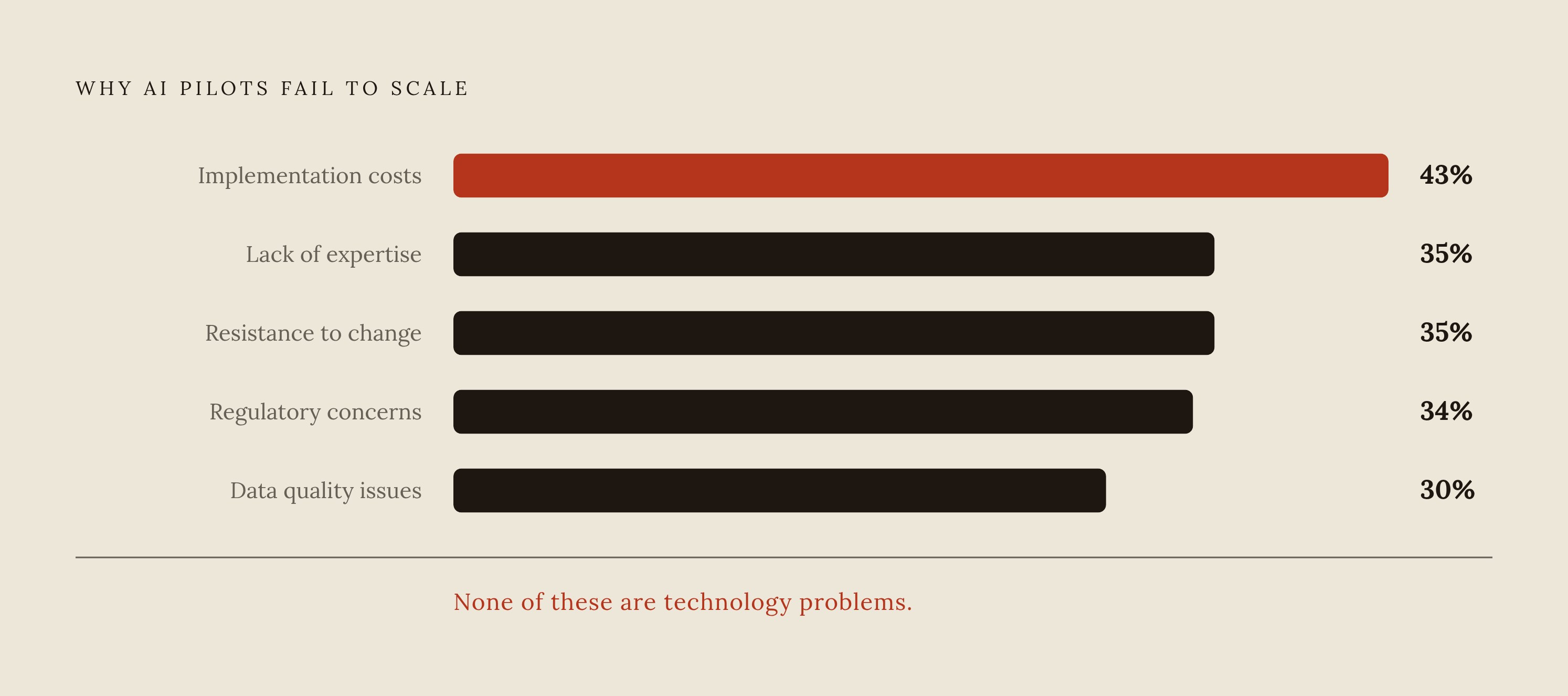
Logistics and manufacturing show the identical substitution, rearranged around networks and processes. In logistics, three forces are reworking North American freight at once: AI-driven customs automation, the rise of commercial drone delivery networks, and a surge in warehouse construction driven less by consumer spending than by the physical footprint AI infrastructure itself requires. Treating those three as separate technology purchases rather than one connected redesign of the freight network lets contracts, carrier relationships, and physical footprints drift out of alignment with each other, each optimized for a version of the network that no longer matches reality. Manufacturing tells a more measured version of the same story with numbers attached. Deloitte's June 2026 survey of more than 140 manufacturers found 84 percent already generating measurable value from AI, yet only about one in five use cases has been scaled consistently across sites or across the enterprise. The gains Deloitte's respondents report in equipment availability, maintenance cost, and cycle time are described as potential rather than realized, which makes the gap a matter of scaling and governance, not a technology shortfall. The barriers manufacturers cite most, high implementation costs at 43 percent, lack of technical expertise and resistance to change tied at 35 percent, regulatory and compliance concerns at 34 percent, and data availability or quality issues at 30 percent, are every one of them operational conditions a platform cannot supply on its own. The pattern matches construction closely: AI investment concentrates where data is already richest and ownership already clearest. The places most likely to receive a platform purchase are not necessarily the places where the groundwork has actually been done.
Pilot purgatory as a predictable result, not a temporary phase
Across all of these sectors, the inability to move AI pilots into production is treated as a maturity problem that more time will eventually solve. It is better read as evidence that the groundwork needed for scaling was never laid before the pilots started. An IDC survey of hundreds of organizations, conducted with AWS, found most enterprises still stuck at the proof-of-concept stage, with a wide gap separating active experimentation from genuine scale across multiple departments. The reasons cluster in a consistent set: an operating model that cannot actually support what the pilot demonstrated, no executive clearly owning the decision to scale, data infrastructure built around curated pilot data rather than the messier data production actually generates, and change management that left the people who'd use the system out of building it. Agent sprawl makes the problem worse. The same IDC data shows roughly half of organizations already running ten or more agents in production, mixing custom-built and purchased systems, to the point where teams lose track of what their own agents are doing, what data those agents can reach, and how they're arriving at decisions. The same gap exists between what leadership believes and what is actually happening on the ground, visible between a construction schedule and the conditions a superintendent finds on site. MIT's study from Project NANDA, "The GenAI Divide," found that 95 percent of generative AI pilots produce no measurable effect on profit and loss despite the scale of investment behind them. Read as a technology verdict, that number is damning. Read correctly, it is an operational one: the systems largely did what they were built to do. The organizations around them hadn't done the work to make that performance matter.
What operational clarity requires before a platform decision is meaningful
Operational clarity is the demonstrated ability to say, in concrete terms, how a process runs today, where it tends to break, and who is responsible for each point where it does. Without that, no platform decision has a defensible basis behind it, whatever the vendor's roadmap promises. The discipline this depends on is the process audit, fieldwork that tests whether controls hold up in actual practice rather than merely on paper, and it is the necessary starting point because it is the only reliable way to expose the gap between the process as declared and the process as it actually runs. Standardization has to come before automation, not alongside it: if a process can't be described clearly and consistently, an agent will not execute it reliably, and pushing automation onto a process that needs to be redesigned first does not fix it, it accelerates the failure that was already there. The sequence that holds up in practice is straightforward to state even if it's hard to do. Find the single process that is most painful and most frequent. Describe it exactly as it runs today, not as the org chart or the manual says it should run. Identify where it breaks and who is responsible for each break. Redesign it before any agent touches it. McKinsey's AEC framework calls this same discipline working in "transforming domains," end-to-end processes narrow enough to redesign on their own but large enough that fixing them actually moves the business, which is close to the opposite of a platform-first, enterprise-wide transformation roadmap. Deloitte's manufacturing findings point the same direction: manufacturers get more by aiming AI at the small number of process areas where complexity, variability, and business value overlap most, rather than spreading it evenly across the enterprise, especially given that 30 percent of manufacturers still cite data availability or quality as an active obstacle. A useful test follows from all of this: the first AI-first process an organization builds should reach production in weeks, not quarters. A long timeline is a sign that the starting point was the wrong one, a platform strategy or a broad transformation roadmap, chosen in place of the narrower, harder work operational clarity actually requires.