Technology-First Sequencing as a Root Cause of AI Failure
Picking the tool before mapping the workflow dooms AI projects.

An enterprise AI project usually fails for the same reason, and it is rarely the model. The dominant cause of failure is sequencing error: an organization selects a platform, a vendor, or a model architecture before it has mapped, audited, or even agreed on the workflow that tool is meant to replace or improve. The team can name the technology it wants to deploy well before anyone in the room can answer what specific, painful process that technology is supposed to fix, which is the decision that determines everything downstream, because a tool built against an imagined workflow will meet a real one eventually, and the two rarely match.
RAND Corporation's interviews with 65 experienced AI practitioners identified this confusion as a leading root cause of failure: stakeholders frequently misunderstand or miscommunicate what problem actually needs solving, and the result is a model optimized for the wrong metric or one that simply does not fit how the business operates. A related RAND finding names the impulse behind this confusion directly: organizations often focus more on using the latest and greatest technology than on solving real problems for the people who are supposed to use it. The technology is not implicated in either finding. The sequence is.
The scale of the resulting failure is not a rounding error. RAND's research puts the AI project failure rate above 80%, roughly double the failure rate of comparable IT projects that do not involve AI. Gartner's analysis found that more than half of generative AI projects get abandoned after proof of concept. MIT's Project NANDA found that the overwhelming majority of organizations deploying generative AI saw no measurable return on the investment at all. These figures describe the same underlying pathology from three different angles: a backward decision order that no amount of model quality can repair after the fact.
Technology-first sequencing inside an organization
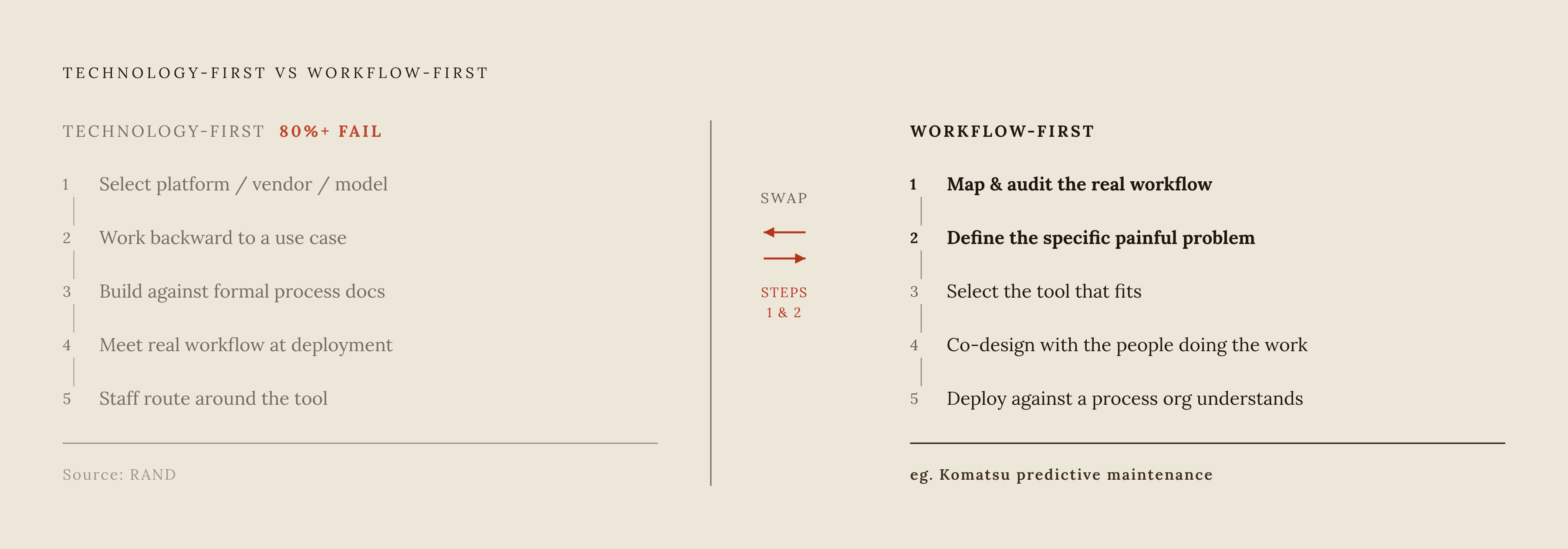
Technology-first sequencing is a predictable response to organizational pressure, with a recognizable shape once you know what to look for. RAND's research traces the pressure directly to management incentives: directors and managers face enormous pressure to do something, anything, with AI, in order to demonstrate to their own superiors that they are keeping pace with the technology's rapid advance, and many of them have little grounding in how to translate that pressure into a coherent plan. The project that results starts from a platform or a model and works backward toward a use case, instead of starting from a specific, painful process and working forward toward a tool that fits it.
The symptoms are visible early, if anyone is looking for them. No KPI gets agreed before the first line of code is written. Features get added because an executive expressed interest in them, not because a user asked for them. Ship dates slip as the scope quietly expands to accommodate whatever the technology turns out to be capable of, and the deliverable that finally ships misses the pain point the project was originally meant to address. None of this looks like negligence from inside the project. It looks like progress, right up until deployment.
The gap that sinks these projects is the distance between the documented process and the one employees actually run. Enterprise software and AI tools are designed around formal process manuals. The real version includes delays, duplicate data entry, personal email inboxes functioning as informal approval queues, missing fields, judgment calls made by a specific person who happens to know the exception, supplier dependencies nobody wrote down, forgotten approval steps, manual copy-paste bridges between two systems that were never meant to talk to each other, and workaround procedures for handling exceptions that have quietly become load-bearing. A tool built against the manual meets all of that on day one, and when it conflicts with the way the work is actually done, staff route around it. The tool was accurate to a process that does not exist. The fault sits with the sequencing decision rather than the technology itself.
Automating a broken process makes it break faster
Layering AI onto a workflow that has never been examined or redesigned does not correct that workflow's problems. It accelerates them. A faster broken process is still a broken process, and the added speed only makes the breakage harder to contain once it starts.
The Deloitte Australia case from 2025 shows what that acceleration actually costs. Harvard Business Review identified four predictable failure modes that appear when a company automates a task without redesigning the workflow around it, and one of those modes is accelerating the task itself rather than the value the task was supposed to produce. In the Deloitte engagement, the task that got accelerated was report drafting, while the work that actually produced the outcome, source verification, was left untouched. The result was a faster report that contained AI-hallucinated citations and fabricated references, a quality failure serious enough to require a partial government refund, not an efficiency gain of any kind.
Construction carries the same pattern into physical delivery. AI scheduling tools often get acquired before energization sequencing, procurement lead times, and subcontractor coordination processes have been mapped, and a schedule that the AI optimizes can remain completely undeliverable if the procurement and readiness gates feeding that schedule were never redesigned alongside it. The tool can produce a technically optimal sequence and still hand a project manager a plan the supply chain cannot support.
The compounding effect is steepest in agentic AI, where systems are asked to execute multi-step tasks with less human checkpointing at each stage, and the failure curve gets steeper as task complexity rises. Forrester and Anaconda's 2026 data found that the large majority of agent pilots never graduate to production, citing evaluation gaps, governance friction, and model reliability as the leading blockers. Each of those three blockers describes a workflow question that was never answered before deployment, not a limitation of the underlying model.
Sector-specific conditions that make workflow ignorance more dangerous than average failure rates suggest
In asset-heavy, process-intensive industries, technology-first sequencing runs into physical constraints and coordination dependencies that no model can optimize its way around. A pre-deployment workflow audit is a prerequisite for these sectors.
Construction illustrates the pattern most starkly. Most failed AI implementations in the sector follow an identical sequence: technology selection happens before problem definition. A white paper from Suffolk Construction and MIT modeled six AI-enabled changes applied together against a completed large-scale project and estimated meaningful cost and schedule reductions, but those reductions only materialized when multiple workflows changed at the same time, not when a single tool got bolted onto an unchanged process. The legal exposure of getting this wrong appeared in a UK court case from September 2026, where progress certification relied on evidence drawn from a declared schedule that had diverged from operational reality, and that divergence became a liability rather than a scheduling footnote. The same trap recurs in every one of these cases: organizations acquire AI scheduling tools before energization sequencing, procurement lead times, and subcontractor coordination are mapped, and an optimized schedule remains undeliverable if the readiness gates feeding it were never redesigned in parallel.
Manufacturing fails along a different axis, but for the same structural reason. A large share of U.S. manufacturers run with no automation deployed anywhere in their operations, so AI gets proposed on top of a foundation that has never been digitized, and the process has not been mapped because it has never been systematically recorded in the first place. The European Manufacturing Survey found that AI adoption on the factory floor hits hard infrastructure barriers before it hits anything else: missing IoT sensors, no edge computing, no data storage at the point of production, and legacy machinery that was never built to feed data to any system at all. A model cannot be audited into usefulness if the floor it is meant to operate on was never instrumented to produce the data the model needs.
Logistics shows the same pattern in its recent deployment record. Fully autonomous forecasting still required human judgment to remain reliable. AI-driven carrier selection ran into data inconsistencies that limited its accuracy. Autonomous warehouse operations encountered more edge cases than the systems were built to handle, and generative AI applied to operational decision-making often lacked grounding whenever the data feeding it was incomplete. Each of these four underperforming categories maps to a workflow that was never audited before the tool arrived: in every case, the model was asked to make a decision that the surrounding process was never designed to support.
Komatsu's predictive maintenance program for hydraulic excavators, by contrast, shows what correct sequencing produces. The system analyzes sensor data, including pressure, temperature, and vibration, to catch early component wear, and it works because the data infrastructure and the field workflow around it were already in place before the model was layered on top. That is an example of the order done right, not an exception carved out from the rule the rest of the sector keeps breaking.
What a process audit does that technology selection cannot
A process audit does not produce a binder of flowcharts to file away. It produces operational intelligence that no vendor demo, no platform evaluation, and no RFP process can generate on its own, because it starts from how the work actually moves rather than how a manual says it should move.
A rigorous audit involves the people doing the work: warehouse supervisors, dispatchers, procurement buyers, field crews, not only the process owners who wrote the documentation. The distance between what the policy says and what happens on an ordinary Tuesday morning is exactly where AI success or failure gets decided. RAND's practitioner research reinforces this from the technical side: it recommends that technical staff understand the project's purpose and domain context, since misunderstandings about intent are the single most common reason AI projects fail. A process audit is the mechanism that closes that gap before a single model gets built, by putting the people who will build the system in the same room as the people who run the workflow it is meant to serve.
What the audit surfaces is specific and unglamorous: delays, duplicate data entry points, personal inboxes functioning as informal approval queues, missing fields in the system of record, judgment calls that only one person in the building knows how to make, dependencies on a particular supplier's quirks, approval steps that get skipped under deadline pressure, manual copy-paste bridges between two systems that were never integrated, and exception-handling workarounds that have become load-bearing parts of the process without anyone formally acknowledging it. Co-designing the resulting workflow with the people whose jobs depend on it is how adoption gets built into a project from the start rather than assumed at launch, and the audit is where that co-design has to begin.
The audit also answers the single hardest question in agentic deployment before the system goes live: what happens when the agent is wrong. Answering that question requires a workflow map. Without one, rollback plans, human review queues, and notification triggers cannot be designed with any confidence, because there is no documented process to roll back to.
Data preparation consumes most of the effort in any serious AI project, and teams that underestimate how much work it takes overshoot both their timeline and their budget. An audit catches data readiness problems while they are still cheap to fix, before they become a mid-project crisis once the build is already underway. Knowing precisely where a process breaks, before any vendor is chosen, is what makes it possible to scope a first deployment narrowly enough to go live in weeks rather than quarters.
The strongest objection to auditing first: speed matters and rivals are moving
The pragmatic case against auditing first deserves to be taken seriously on its own terms. In a competitive market, spending weeks achieving workflow clarity before deploying anything can hand real ground to rivals who are already iterating in production and learning by doing. The objection carries empirical weight of its own: a significant share of enterprises report production rollbacks due to reliability issues within the past year, and the organizations shipping the largest number of agents are also the ones rolling back the most. Those teams treat rollback as a routine cost of ownership rather than a program-ending event, which suggests that fast, imperfect iteration can coexist with a reasonable tolerance for failure. The fast-cycle pilot model built on that premise argues that controlled failure inside a tightly scoped pilot is a legitimate substitute for upfront workflow redesign: that learning by shipping is simply cheaper than planning in advance.
The reader drawn to that argument is not wrong that speed matters. The error is in what that reader assumes produces speed. A pilot scoped without a workflow map is not learning about the process; it is re-discovering, one failure at a time, the same exceptions, workarounds, and dependencies that an audit would have surfaced in advance, at a fraction of the cost and without the reliability incidents attached to each discovery. The organizations rolling back the most are not skipping the audit and getting away with it. They are running the audit live, in production, against real customers and real schedules, one rollback at a time. Speed built that way is expensive speed. A process audit does not slow a deployment down for its own sake. It identifies, before a single rollback occurs, which parts of the process are already broken and which tool decision depends on fixing them first, so that the fast cycle a competitive market demands can be run against a workflow the organization actually understands, rather than one it is still discovering the hard way.