Process Auditing Before AI Deployment in Industrial Operations
Audit your actual workflow before deploying AI to automate it.
A plant manager approves an AI agent to route purchase orders because the documented procedure shows a clean, three-step approval chain. Within a month, the agent is routing orders correctly against the procedure and incorrectly against the plant, because the real approval chain has a fourth step that exists only in the heads of two senior buyers who skip the formal sign-off whenever a supplier threatens to miss a ship date. That is the dominant failure mode in industrial AI deployment: not a weak model, not a bad vendor, but capable AI set loose on a process nobody had actually mapped. Most organizations treat the choice of AI system as the hard problem and treat understanding the process as a formality to clear on the way there. That sequence is backwards. A process built for people to run, full of informal workarounds, tribal knowledge, and exception handling that lives in behavior rather than in any document, is rarely a safe foundation for a system that runs without asking permission. When the AI layered onto it works exactly as designed, it reproduces the dysfunction at scale, producing flawed outputs faster and more consistently than a human ever could, which makes bad automation more expensive than no automation. A systematic review of 130 empirical studies on AI oversight found that traditional governance fails in a specific, recurring way: retrospective checklists, procedures with high formal maturity, and a scientific basis that remains immature, combining into what the review called a pathology of performative governance, where organizations optimize for the appearance of process rather than for safety outcomes that can actually be measured<sup>2</sup><sup>3</sup>. None of this is a governance problem or a vendor problem at root. It is a sequencing problem, and a process audit conducted before any deployment decision is the mechanism built to fix it.
The gap between how a process is designed and how it actually runs
In industrial operations, the process written down and the process actually carried out are almost never the same thing, and the space between them is exactly where AI deployments go wrong. A flowchart or a standard operating procedure captures intended governance: who is supposed to approve what, in what order, under what conditions. It does not capture what happens on the floor when a system throws an exception, a supplier misses a date, or a handoff between two departments breaks down halfway through. What gets designed as a clean linear sequence with a few decision points typically gets executed as a tangled network with dozens of variant paths, informal reroutes around bottlenecks, and rework loops that send work back upstream when something fails quality or completeness checks. Conformance checking, the discipline of comparing what an organization says it does against what its own event logs show it actually did, is the tool that makes this gap visible. It is visible in every point where real execution departed from the designed model: purchases approved without the sign-off the procedure requires, code or configuration changes pushed without passing through the quality gate meant to catch problems first.
Construction offers one of the clearest illustrations. A declared project schedule, built in a tool like P6, records the sequence someone intended to follow. It does not record whether the procurement that enables that sequence is actually on track, whether the coordination handoffs between trades have been resolved, or whether commissioning dependencies have been accounted for. The schedule shows intent, not achievability, and the risk that actually threatens the project lives in the procurement lead times, the coordination handoffs, and the commissioning readiness that the schedule was never built to show. Data center construction makes the stakes concrete. Energization readiness functions as a mission-critical gate, and the commissioning and energization phase alone can run for months. Whether that gate is actually met rarely depends on any live or evidence-generating connection between the civil, structural, MEP, and procurement activities and the ready-for-service date the project is being measured against. Before AI enters a process like this, an organization needs documented evidence of how the process actually flows day to day, not the cleaned-up version assembled for a vendor demo.
What a process audit does
A process audit conducted ahead of AI deployment is an evidence-gathering exercise with one purpose: producing an accurate model of how work actually moves through an organization. It is not a checklist confirming that documented procedures exist somewhere in a shared drive. The audit has to map existing processes down to granular sub-tasks, tracking every data input, every decision point, and every manual handoff between departments. A high-level flowchart cannot do this work; it operates at the wrong resolution.
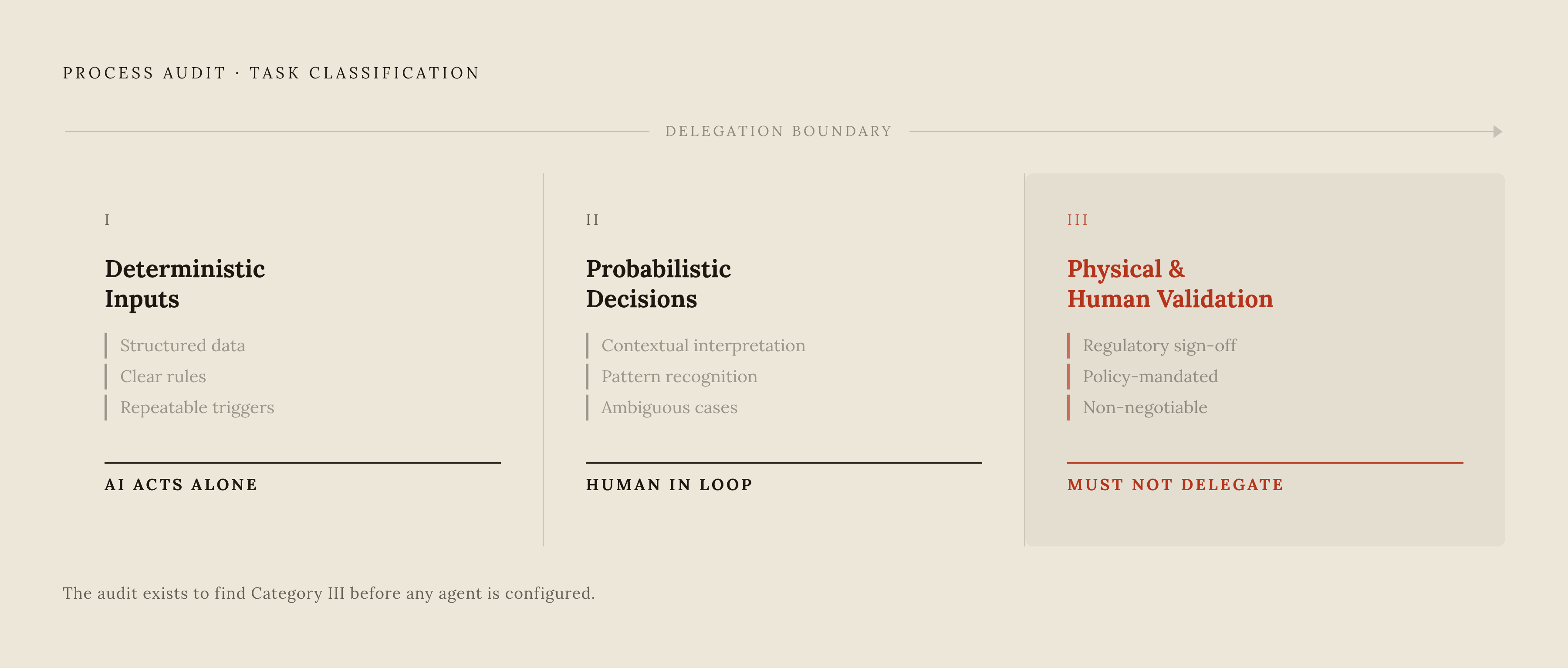
Once mapped, each task gets sorted into one of three categories, and the category determines what posture AI should take toward it. Deterministic inputs are structured data with clear rules and repeatable triggers, the kind of task where AI can act reliably without a human checking its work. Probabilistic decisions involve contextual interpretation, pattern recognition, and flexible logic, the kind of task where AI needs a human in the loop making the final call. Physical and human validation handoffs are steps where regulatory oversight or operational sign-off is mandatory by law or by policy, steps that cannot be delegated to an agent regardless of how well that agent performs elsewhere. This categorization is the actual output of the audit, and it is what makes a deployment decision defensible. It tells an organization not just where AI could theoretically act, but where it should act and where it must not, worked out before any agent gets configured.
It helps to be precise about what this work is not. A process audit is not an AI model audit, which evaluates a model's behavior, its fairness properties, and its regulatory compliance once it is running. That is a separate discipline that applies later, after deployment, to the system itself. Treating the two as interchangeable is one of the more common reasons organizations believe they have already done the pre-deployment work when all they have actually done is prepare for the post-deployment review. A model audit asks whether the AI is behaving correctly. A process audit asks whether the thing the AI was pointed at was ever understood well enough to automate. Skipping the second does not mean the first will catch what was missed; by the time a model audit runs, the automated process is already producing output at scale.
Conducting a process audit that surfaces real operational behavior
A process audit worth doing moves through a sequence, from observation to evidence to decision, and the discipline is in not skipping steps because a deadline is pressing.
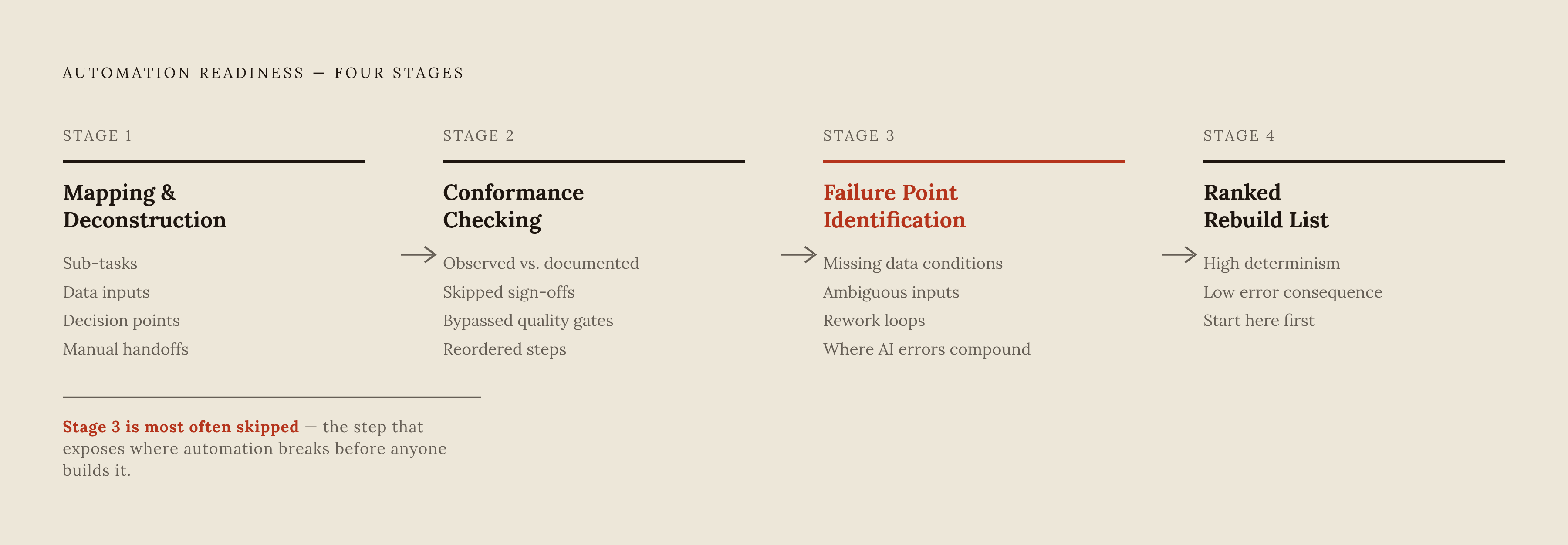
The first stage is mapping and deconstruction. Every workflow gets broken down to its granular sub-tasks before anyone evaluates a single piece of tooling or AI capability, because evaluating tools against an unmapped process just repeats the original mistake one step later. This means capturing every data input, every decision step, and every manual handoff across departments, and it means asking front-line staff what actually happens rather than asking supervisors what they believe happens. The two accounts rarely match exactly. Walking the process with the people who run it day to day reveals the workarounds, the informal escalations, and the extra steps that exist purely because some system upstream produces unreliable data and someone downstream learned to compensate for it by hand. Every task identified this way then gets sorted as deterministic, probabilistic, or validation-mandatory. That categorization is a diagnostic tool for understanding the process, not a shortcut to picking which AI product to buy.
The second stage is conformance checking against the process as it was originally designed. The map built through direct observation gets compared against the documented procedure or the intended workflow, and every deviation gets written down: every place where execution bypasses a control, takes a path the design never anticipated, or loops back for rework the designed model has no record of. Common deviations in industrial settings include approvals granted without the required sign-off, procurement steps reordered because a crew is behind schedule, and quality gates skipped under time pressure. These deviations should not be treated as problems to patch before deployment can proceed. They are the process as it actually runs, and whatever AI agent gets deployed will run into every one of them on day one.
The third stage identifies where automation will break before anyone builds it. For each task category, the audit needs to pin down the specific conditions under which an automated version of that task would fail: missing data, inputs too ambiguous to parse cleanly, handoffs that depend on a judgment call no agent can replicate. Rework loops deserve particular attention here, the points where work returns upstream because an earlier step produced something incorrect or incomplete, because these are exactly the places where errors generated by an AI system compound fastest and hardest to trace. Every step also needs a flag for how costly or irreversible a wrong automated decision would be. In commissioning, in procurement, in energization sequencing, a wrong call made by an automated system does not produce a support ticket. It produces schedule slippage or a missed ready-for-service date.
The fourth stage is choosing which process to rebuild first. The audit's output is a ranked list, sorted along two dimensions: how well the process is now understood, and how costly an automated error in that process would be. The right place to start is a specific, painful process that scores high on determinism and low on failure consequence, not the most visible process in the building and not whatever process leadership has already announced it intends to transform.
Where audits must find the gaps industrial processes hide
Across construction, manufacturing, and logistics, the same structural locations keep producing the gaps an audit exists to find, and they are rarely the processes an organization proposes to automate first.
In construction and mission-critical project delivery, scheduling tools like P6 record what was planned. They say nothing about whether the procurement enabling that plan is actually on track, whether commissioning dependencies have been mapped, or whether the energization date has any real grounding in field conditions. Newer agentic systems that connect on-site activity capture, RFIs, and field reporting directly to the schedule in near real time can expose what manual coordination has been hiding for years. But those systems only work if a process audit has already established which data inputs are reliable and which have been systematically wrong, because connecting a live feed to a bad data source just makes the bad data move faster.
In manufacturing, AI creates the most value exactly where processes carry high variability, many interacting parameters, and consequences that matter operationally, the same conditions under which undocumented process variants are most likely to exist and most likely to break whatever automated handling gets built around them. Because manufacturing involves physical integration, sensors, cameras, robotics, and machine tools, a process error does not wait for a human reviewer to catch it in a report. It propagates straight into physical output before anyone has a chance to intervene. The audit has to map the physical handoffs alongside the digital ones: the point where a sensor reading becomes a decision, the point where a machine action depends on a prior step that may not have finished correctly.
In logistics, the gaps that matter most sit at the integration points between systems, the handoff from a warehouse management system to a transport system, the moment a customs status triggers a release decision, the point where a planning output turns into an execution instruction. These handoffs are frequently manual, a person reading one system and keying data into another, and the audit usually finds that the manual step exists because the two systems were never built to agree on a shared data model, not because human judgment is actually required. Automating that handoff without first auditing why a human was ever put there produces an agent that carries the same data disagreement forward at machine speed, just faster and with less chance for anyone to notice.
Evidence the audit must establish before deployment
The audit is finished when the evidence behind it can answer the questions that will come up the moment the automated process fails, because that moment will come.
A deployment decision needs four categories of documented evidence in hand. The first is how the process actually runs: the discovered model built from direct observation, including every variant and every rework loop, not the version that exists on paper. The second is where that process deviates from its intended design, the conformance record showing which controls get bypassed, how often, and under what conditions. The third is the categorization the audit produced of which steps are safe to hand to AI and which require a human judgment call or regulatory sign-off. The fourth is what happens if an automated step produces a wrong output, a risk assessment built from operational reality rather than from theoretical error rates pulled from a vendor's marketing material.
This evidentiary standard matters for running the operation, not only for satisfying an auditor. An organization that cannot answer these four questions before deployment cannot diagnose what went wrong after something breaks, and cannot improve the automated process once it is live, because there is no baseline to compare against. The standard also now carries regulatory weight. The EU AI Act's obligations for high-risk systems, which took effect in August 2026, require conformity assessments, bias mitigation and data governance measures, and documented evidence of human oversight mechanisms, and that evidence has to be generated before deployment rather than reconstructed from memory after something has already gone wrong. An organization that treats the process audit as a formality to compress on the way to deployment is pushing the same evidentiary work to a later point where producing it will cost far more.
Rebuilding the process is what the audit makes possible
The audit's purpose was never to draw a more accurate picture of a broken process and stop there. It exists to build the evidence base an organization needs to design a genuinely better process before AI gets introduced into it. The failure mode this piece opened with, AI amplifying dysfunction instead of fixing it, only gets avoided once an organization has decided, on the strength of audit evidence, what the process should actually look like rather than settling for a faster version of what it currently is. A plant manager who maps the real four-step approval chain, including the two buyers who skip formal sign-off under supplier pressure, is no longer choosing between automating a flawed procedure or leaving it alone. There is a third option: redesign the chain so it matches how the work actually has to get done, then automate the version that survived contact with reality.