Why P6 Schedules Fail as Operational Risk Instruments
Deterministic schedules hide risk behind optimistic math and outdated data cycles.
Primavera P6 fails as an operational risk instrument because it was never built to be one. It is a contract-compliance and sequencing tool, and whatever risk-management value it offers is a side effect of that design, not its purpose. Understanding what P6 is built to do is the only way to see clearly where it stops working.
P6 organizes a project into a hierarchical Work Breakdown Structure, attaches durations and logic relationships (various dependency types linking activities in sequence) to each activity, and calculates a critical path from that network. The result is a logic-driven picture of planned sequence and timing, built on classic scheduling-network mechanics: activities, durations, dependencies, and a data date that marks where the project officially stands. Milestones sit inside that structure as zero-duration markers, bookmarks of intent rather than sensors that detect what is actually happening on site.
The center of the whole system is the baseline. Once stakeholders approve it, the baseline becomes the plan that every future comparison runs against: delivered work gets measured against the baselined schedule at a given point in time, and the gap between the two becomes the project's reported status. That makes P6 a measurement frame, not a steering frame. It tells a team how far it has drifted from a plan that was fixed at approval. It does not tell a team what is about to go wrong next.
None of this is a flaw in the tool. It is what P6 was designed to do, and it does that job well enough to remain the dominant scheduling platform across construction, oil and gas, infrastructure, and heavy engineering, the very industries where operational risk runs highest. An instrument built to document planned intent and satisfy contractual reporting obligations is routinely handed the job of warning operations leaders about risk before it happens. That is a different job, and the rest of this piece traces where the two jobs come apart.
Why deterministic schedules produce optimistic answers by design
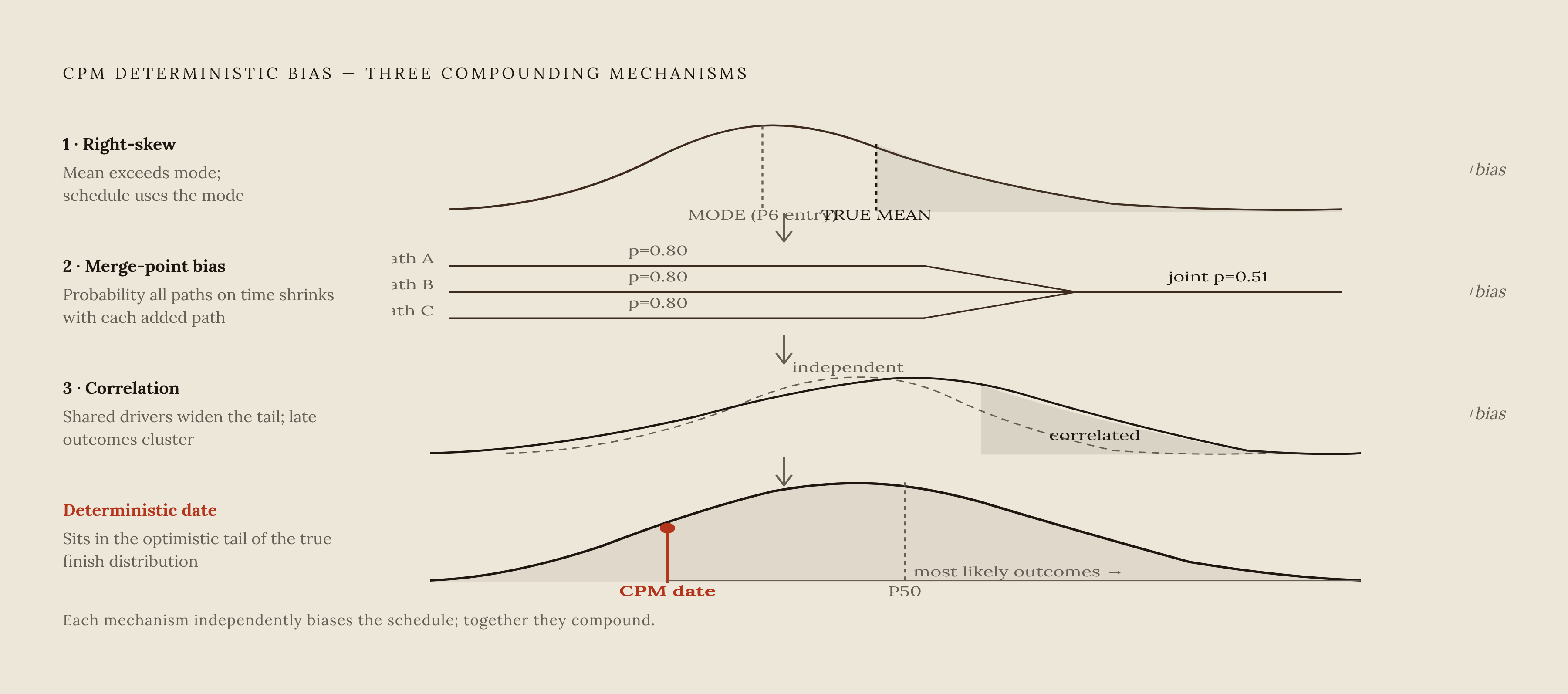
Before a single crew shows up late or a single shipment misses its slot, the P6 schedule is already biased toward an optimistic answer. Three mechanisms compound to push a deterministic finish date earlier than any realistic outcome, and all three operate regardless of how skilled the scheduler is.
The first is right-skew in task durations. For any given activity, there are far more ways for the work to take longer than planned than there are ways for it to finish early: a weather day, a late inspection, a design clarification, a subcontractor pulled onto another job. Schedule risk analysis treats this as a known property of construction data: task durations are right-skewed, so the realistic average duration already sits above the single most-likely value a planner enters into P6. That gap exists at the level of one activity, before any dependency is even considered.
The second mechanism is the merge point, where two or more parallel paths converge into a downstream activity that can only start once the latest of the incoming paths finishes. Even when each individual path is only occasionally late, the probability that none of several converging paths is late shrinks every time another path is added to the merge. A deterministic P6 schedule has no mechanism for pricing this effect: it simply takes the planned finish of each path at face value. Simulation prices the merge effect automatically, which is one reason simulated finish dates almost always land later than the single deterministic date a conventional P6 report shows.
The third mechanism is correlation. When the same driver, the same stretch of weather, the same crew's productivity, the same immaturity in a design package, affects many activities at once, the good and bad luck across those activities stops canceling out, and the range of plausible finish dates widens. A schedule risk analysis that ignores correlation between activities will produce a result that looks precise and is wrong, because it quietly assumes that risk in one task has nothing to do with risk in the next.
Put together, these three mechanisms mean every deterministic P6 schedule represents the best case drawn from a distribution of outcomes that is heavily weighted toward late ones. When an operations leader reads a single CPM finish date as a commitment, what is actually being read is a structural artifact of how CPM math handles uncertainty, not a forecast of what is likely to happen. Adding more activities, more detail, more granularity to that same deterministic structure does not fix this. It only gives the optimism more places to compound.
How Update Cadence Detaches the Schedule from the Field
Even a perfectly built P6 schedule breaks down as a risk instrument because of how it gets maintained in the field. The update cadence runs on contract pay-application cycles, not on the pace at which decisions actually get made on site, and that mismatch puts the schedule and the project on two different clocks.
Baseline schedules often exist in the first place because the contract requires one. Once approved, that baseline may go years without a substantive revisit. The periodic updates that follow get submitted because each pay application requires one, and what often changes between updates is the dates on paper rather than any real reflection of what crews did that period. The schedule keeps looking current. It is not tracking the work.
That mismatch has a concrete shape. The space between the schedule's view of the project and the project's actual state is continuous when updates happen every two weeks while crews make sequencing and staffing decisions every two hours, and it never closes between update cycles. P6 is a tool built for planners, and the people making real-time calls in the field mostly do not touch it. Superintendents run their day off whiteboards and text threads, foremen estimate how long a task will take from experience rather than from the schedule, and project managers approve change orders based on progress assumptions that are already weeks stale by the time they reach a desk. Any adjustment that needs to make it back into the live schedule has to travel through a scheduler, which slows the system's response to whatever just changed on site.
A crew that was not mobilized on an activity until weeks after its scheduled start date appears in daily reports and labor records, revealing a fact that only a labor log captures. The project and the schedule diverge continuously in the space between updates, and the timing of those updates is set by contract obligation, not by where risk is actually building up on the ground.
Where real risk lives: procurement, coordination, and commissioning
The risks that end projects, as opposed to merely slow them down, tend to come from three places: long-lead procurement failures, coordination gaps between trades, and commissioning readiness shortfalls. All three are structurally invisible to a CPM schedule, for a simple reason: none of them is a construction activity with a start date, a duration, and a finish date that fits into P6's network logic.
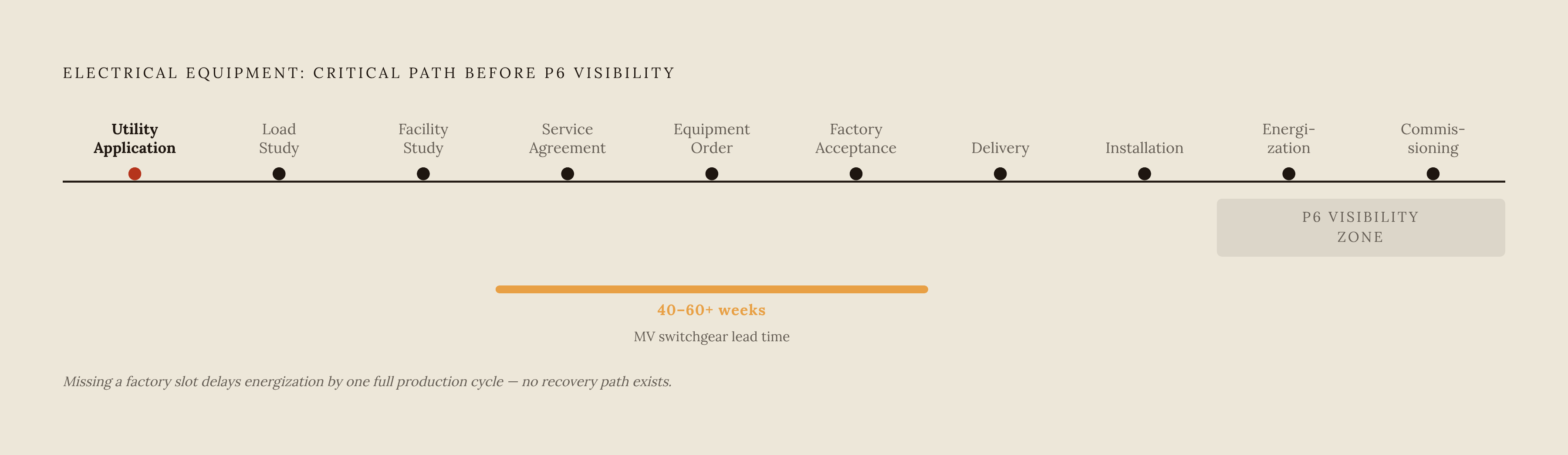
Procurement is the clearest case. On a mission-critical build, the windows for ordering long-lead equipment, securing a factory slot, and completing factory acceptance testing often sit ahead of mobilization, and they function as the real critical path of the project even though P6 has no native way to model them as first-class risk events. A realistic risk picture needs separate milestones for the utility application, the load study, the facility study, the service agreement, the equipment order, factory acceptance testing, delivery, installation, energization, and commissioning, not one blended energization date standing in for all of it. Contractors who place long-lead electrical orders before design is fully frozen cut real schedule risk; projects that wait for a completed design before ordering equipment routinely slip by months as a result. Missing a submittal approval window on long-lead equipment costs the loss of a factory production slot, which pushes the energization date back by a full production cycle, a loss that overtime and resequencing cannot recover.
Coordination gaps work differently but land just as hard. The space between when one trade finishes its scope and when the next trade needs that scope complete to start its own work accumulates quietly inside the schedule's logic links, invisible until it erupts on site. Trade contractors who cannot see an updated lookahead schedule in context end up over-staffed or under-staffed for the week ahead, and a slip becomes a live problem by the time it is visible in the schedule itself.
Commissioning readiness sits furthest from anything P6 models well. A facility can hit Substantial Completion exactly on schedule and still be inoperable, because the prerequisites for commissioning, equipment actually delivered, energization formally approved, authority sign-off secured, are activities the schedule was never tracking.
The clearest evidence of all this is the gap itself. When procurement records show a critical material arrived late and the P6 schedule was never adjusted to reflect that delay, the schedule and the field are telling two different stories about the same project. It shows how much confidence the schedule's forward-looking dates actually deserved.
The data center buildout as a precise proof case
Nothing demonstrates this structural blind spot as cleanly as the current data center buildout, where the binding constraint on an entire project can sit completely outside what a conventional CPM schedule tracks. The bottleneck is a physical procurement constraint that exists before mobilization ever starts.
The arithmetic of the failure is stark: electrical transformers, switchgear, and battery systems make up a small fraction of total data center construction cost, yet without them, everything else that capital bought, the shell, the cooling systems, the racks, the compute, cannot be turned on. Brennan Church, Director of Engineering, Procurement and Construction at Hut 8, described the current state of the supply chain directly: "The biggest bottleneck we are seeing is on long-lead electrical equipment. Switchgear, transformers and generators are all running extended lead times, with medium voltage switchgear often at 40 to 60-plus weeks. A shell can be completed and mechanically roughed in, but if the gear isn't onsite, you're not energizing." A lead time of 40 to 60-plus weeks runs roughly 10 to 15 months or more. A missed factory slot pushes energization back by a full production cycle. No amount of acceleration on site recovers that lost time.
Power infrastructure constraints are already stretching timelines at specific locations: projects in Northern Virginia have reached physical completion and then sat dark for extended stretches, waiting on utility energization, a failure mode that a P6 schedule reporting "Substantial Completion" has no way to surface.
The Vantage Data Centers and Oracle campus in Wisconsin, known as Project Lighthouse, shows the same dynamic playing out at the regulatory level, a layer that sits entirely outside any contractor's schedule. Vantage is developing the four-building campus with Oracle and OpenAI as tenants, with total electricity demand for the site running to roughly 1.3 gigawatts. American Transmission Co. applied in September 2025 for approval of more than $1.3 billion in transmission infrastructure tied to the project, with the full scope of the build estimated to be roughly double that amount. Wisconsin regulators subsequently withdrew their determination that the application was complete, after the scope changed substantially, forcing ATC to restart the approval process from scratch. That restart does not appear as an activity on any contractor's P6 schedule, yet it is a risk event sitting upstream of every milestone on the build.
The pattern scales nationally. A large share of U.S. data center projects planned for 2026 are now expected to face delay or cancellation, and the constraint driving that has shifted away from capital and compute toward power infrastructure itself: electricity supply, transformers, switchgear, and battery systems. A P6 schedule for one of these builds models construction sequence in careful detail. The constraint that actually decides whether the facility goes live on time is supply-chain physics, a layer the schedule was never built to see.
Why Monte Carlo Risk Modules Inside P6 Don't Close the Gap
The strongest objection to everything above is that P6 already has risk tools built for exactly this problem, through schedule risk analysis and Monte Carlo simulation layered onto the CPM network. That objection is correct as far as it goes, and it clarifies what the gap is and is not.
Schedule risk analysis does real work. It takes single-point duration estimates and turns them into ranges, prices in the merge-point bias and the correlation effects described earlier, and produces P50 and P80 finish dates that a team can commit to with a stated level of confidence, rather than a single date that everyone on the project quietly disbelieves. Run properly, it applies Monte Carlo simulation across the schedule to generate distributions of finish dates and cost outcomes. A credible version of this analysis also separates different kinds of uncertainty rather than lumping them together: how much work there actually is, how fast a crew can do it, discrete risk events like a delayed permit or a late material delivery or a round of rework, and ongoing disruption. Folding a discrete risk event into a duration range instead of modeling it separately hides its effect on the tail of the distribution, where the real damage happens.
This analysis can only model risks that were encoded as activities in the network to begin with. The starting point for any schedule risk analysis is the plan already sitting in P6, its tasks, its logic links, its calendars. The simulation measures how much confidence that plan's single answer deserves. It cannot measure a utility application that gets sent back for revision, a factory production slot that closes, or a regulatory completeness determination that gets withdrawn, because none of those exist anywhere in the schedule for the simulation to vary. A schedule that runs on hard-coded dates rather than modeled logic cannot respond to simulated variation at all, and most P6 schedules built to satisfy contract compliance contain exactly that kind of hard-coded constraint.
The most common failure in practice is stopping at duration ranges and calling the job done. That captures the everyday variability in how long tasks take. It does not capture the events that actually blow up a schedule: a withdrawn regulatory filing, a canceled equipment order, a utility that cannot energize on the date everyone assumed. Schedule risk analysis sharpens the math inside the fence P6 already draws around a project. The risks that end projects mostly live outside that fence, in procurement, in coordination between trades, in commissioning readiness, exactly where the schedule was never built to look.