Multiparty Data Coordination in EPC Project AI Deployments
Fixing AI in EPC projects requires redesigning data flows between organizations first.
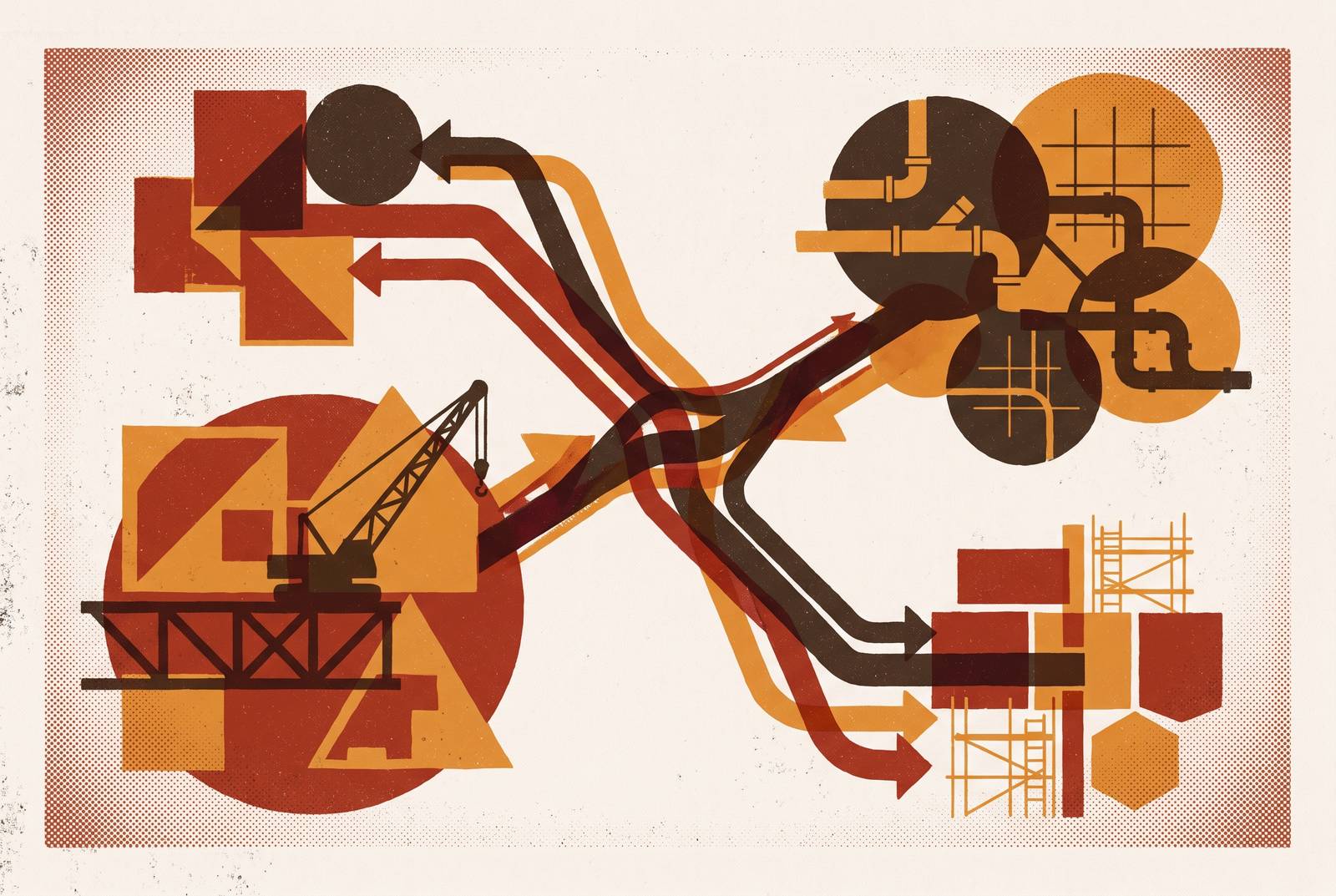
Multiparty data coordination is the limiting factor in EPC project AI deployments. For deployment to be reliable, teams must rebuild how data moves between organizations before they put an agent inside the workflow. Connecting systems without redesigning those handoffs leaves the agent dependent on the same incomplete inputs and unresolved authority that already constrain project decisions.
Why AI deployments in EPC projects stall before the first agent runs
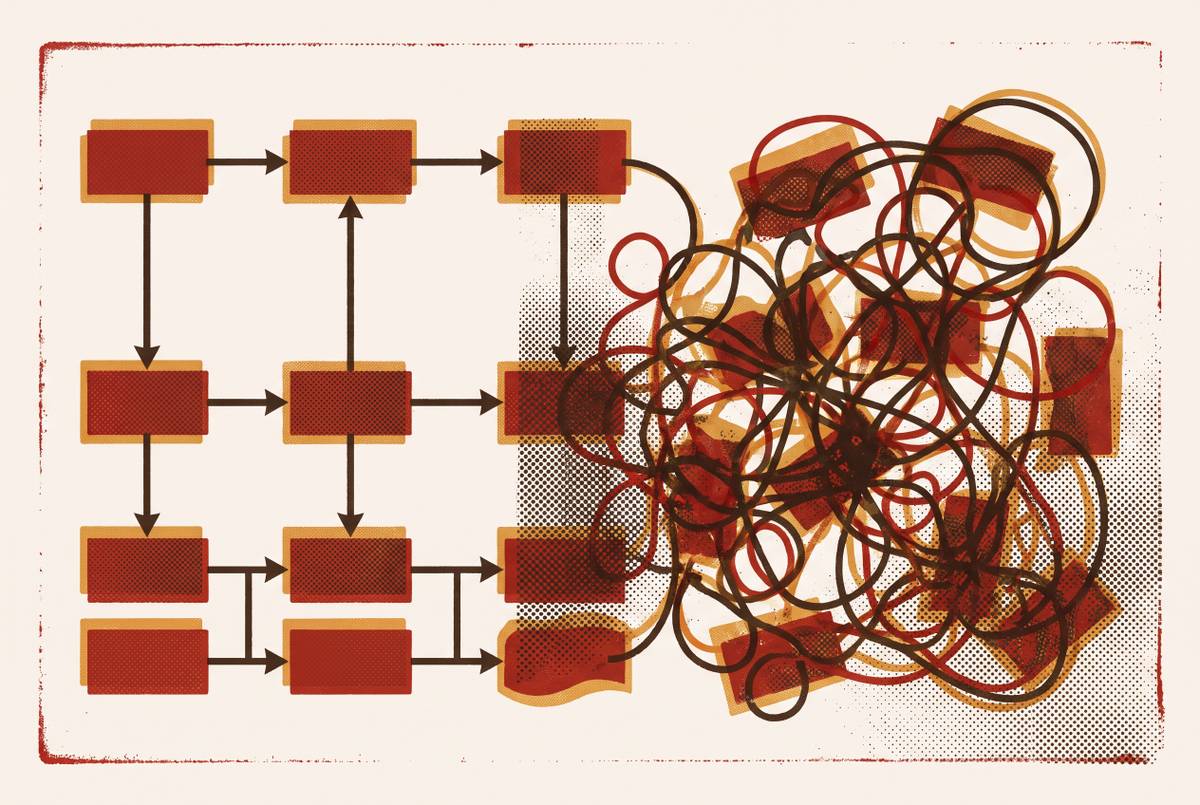
An EPC project is a coordination structure spanning multiple owners, systems, and phases, while most AI deployment frameworks assume a single enterprise, governed data, and unified identity. Schedule, cost, procurement, and engineering records belong to separate organizations operating incompatible systems at the same time. Those organizations participate in one project without becoming one enterprise. The boundaries set by their contracts and organizations still shape every decision that depends on shared information.
That mismatch explains the gap between a controlled demonstration and reliable operation on a live project. A demonstration can bring the inputs an agent needs together, but on a live project, who owns those inputs, how good they are, and when they are available differ from party to party. Ungoverned inputs produce unreliable outputs regardless of the model's reasoning capability. The MAP study (UC Berkeley et al.) found that reliability, meaning consistent correct behavior over time, is the top development challenge practitioners report across deployed agent systems. Its finding that teams address reliability through systems-level design supports the diagnosis here, though in EPC no single organization controls the whole operating environment.
How EPC project structure produces fragmented data by design
The project brings together owner organizations, engineering firms, procurement chains, specialty contractors, equipment vendors, and grid operators. Each works to its own schedule, uses its own data definitions, and has authority over its own records. The process groups of initiation, planning, execution, monitoring, and closeout cross those organizational boundaries. As a result, fragmentation is the structural outcome of dividing delivery responsibilities among parties without giving one party authority over the whole.
Labour staffing gaps require actual staffing against plan, while schedule divergence requires activity patterns against the baseline. Comparing cost burn against earned value and procurement lead times against schedule demand also depends on records that other parties hold. A change order review makes the problem especially clear because it touches cost, schedule, procurement, and legal, with data owned by the contractor, owner, engineer, and subcontractor simultaneously. Even a capable agent needs the parties to coordinate access to the information they hold to review that change correctly. The decision is shared, but the evidence needed to make it is not governed as a shared input.
What happens when teams treat data coordination as a technical integration problem
The dominant response is to connect APIs, normalize schemas, build a data lake, and deploy agents on top. This makes records easier to reach, but it may leave questions about their ownership, quality, or authority unresolved. AI data center construction depends on coordination among delivery parties at infrastructure scale. A majority of announced U.S. capacity for 2026 was not under construction as of mid-year, with a large share of projects delayed or cancelled amid failures to coordinate dependencies among delivery parties in procurement, grid interconnection, and commissioning sequencing.
Long-lead equipment, including transformers, switchgear, and chillers, requires confirmed order dates that depend on information held separately by procurement, engineering, and owner parties. Late or uncoordinated ordering compresses commissioning and can stall the facility. PJM data showed that permitting, supply chain, and EPC procurement issues accounted for a dominant share of milestone change requests on projects under construction or development, with supply chain and procurement delays alone accounting for nearly a quarter of all milestone changes. Connecting records after ordering decisions have been made does not repair the sequence that produced those delays.
When an agent uses those uncoordinated streams, problems in the data become risks to the decisions it helps make. Its outputs can appear plausible despite resting on incomplete or conflicting inputs, allowing errors to propagate into downstream decisions before they surface. Better integration tooling does not resolve a missing agreement about when evidence must arrive or who may act on it. The starting point must therefore change from connecting records to designing the decisions those records support.
Why data coordination in EPC is a process design problem, not a technical one
Designing how data should move between parties at each decision point first requires an audit of how the process actually runs, rather than a map of the systems that record its results. That audit identifies which data an agent needs, which party produces it, when it becomes available, and under whose authority it can be used. These elements constitute the agent's context. They do not form automatically when two systems are connected.
For example, a procurement agent can flag a conflict between an expected electrical equipment delivery date and a planned installation date only if it can see both the procurement record and the schedule baseline. The parties must also agree that the agent may surface a cross-organizational conflict and define what that flag can trigger. Where process group-specific agents and role-based agents exchange information, communication protocols, conflict-resolution mechanisms, and decision models must prevent conflicting actions, redundancy, and feedback loops.
The MAP study (UC Berkeley et al.) found that production teams choose to trade capability for controllability by using static workflows, capped step counts, and human-in-the-loop gates. For EPC teams, the corresponding work is to locate the boundaries where data stalls and decisions proceed on incomplete inputs. The audit then reveals both the redesign and the appropriate location for an agent. If teams skip it, they risk building the wrong capability at the wrong point in the process.
The specific processes in EPC where data coordination failures are most consequential
Long-lead procurement sequencing is a high-risk starting point because an order decision depends on equipment specifications from the engineering contractor, budget authority from the owner, and a connection date from the grid operator. These parties have separate systems and typically no shared data governance. A procurement agent acting on stale or incomplete lead-time data can trigger a reorder that compresses commissioning. The consequence is not confined to schedule performance because compressed commissioning can create safety risk. The critical handoff is therefore the arrival of the required evidence before the order decision.
Commissioning readiness has a related but distinct dependency. Milestones must be tied to energization because practical completion, with finished concrete and steel, does not establish that the grid connection, switchgear, and commissioning team are ready together. Grid energization adds ten months to the back end of the programme in Ireland and six months in Virginia. Those timelines are part of the utility's process, outside the EPC contractor's schedule, and the parties need to share them even though their contracts do not require it. A readiness signal needs the utility's interconnection schedule, the contractor's installation progress, and the vendor's delivery commitments all at the same time.
Earned value and change order monitoring fail when records pass between contractors at different speeds. To compare cost burn with earned value and change order accumulation, teams need to bring together the owner's cost data, the contractor's earned value data, and the engineer's change order data in near-real-time. An approved change order missing from the contractor's earned value calculation creates phantom float that misleads downstream reasoning about schedule or budget risk. All three failure points share the same structure, namely separately owned data, a decision requiring it simultaneously, and no designed pathway for its timely arrival.
What rebuilding the data flow process looks like before an agent is deployed
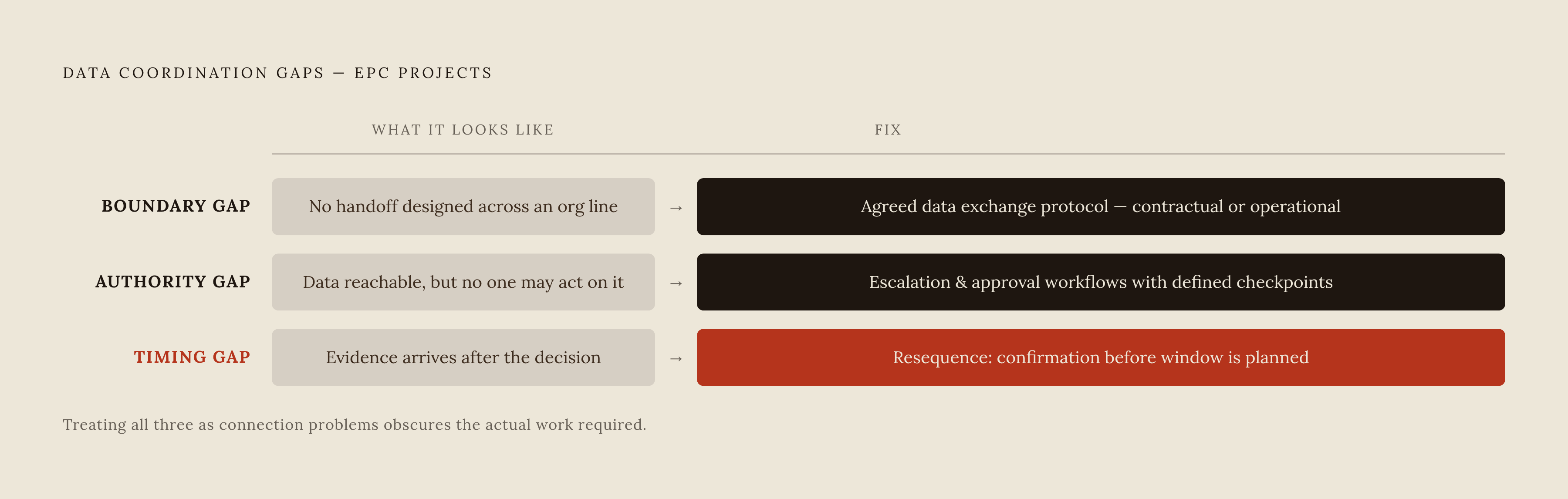
Rebuilding starts with an audit of a specific high-value process as it operates today. The audit traces who produces each input, when they produce it, which system holds it, and whose authority governs its use. It distinguishes a documented procedure from the actual handoffs on which decisions depend. The findings fall into three categories, which are boundary gaps, authority gaps, and timing gaps. Each category calls for a different change, so treating them all as connection problems obscures the work required.
A boundary gap exists when information must cross an organizational line but no designed handoff exists. An engineer's specification that procurement cannot consume without manual re-entry requires an agreed data exchange protocol, established contractually or operationally. An authority gap exists when connected data is available but nobody has defined who may act on it. That gap requires escalation and approval workflows stating who reviews a flag, who can act, and which human checkpoint precedes a decision. A timing gap instead requires resequencing, so a delivery confirmation arrives before an installation window is planned around an assumed date.
Human review belongs in this sequence rather than being added after an agent produces a disputed result. MAP's 2025 analysis found that 74% of deployed agents depend primarily on human evaluation, reinforcing the importance of evaluation without removing the need to design operational checkpoints. In EPC, acting on an unverified input can create liability. Once the relevant gaps are closed, the agent can be placed inside the redesigned workflow. Deployment is the last step, because starting with the agent leaves the broken process beneath it.
How multiparty data governance and agent identity are designed into the rebuilt process
Every exchange needs a defined identity for the agent or role accessing it, a classification reflecting its sensitivity or regulatory obligations, and an audit trail showing what happened and who acted. A single enterprise's controls cannot govern the shared environment by assumption. Each party on the project has its own identity system, classification rules, and compliance obligations. The parties need to agree on a governance layer that works across their systems.
Each agent needs a governed non-human identity for each data source, with least-privilege access to just the information it needs for its task. Sensitivity labels and access controls must apply when data crosses the organizational boundary. Audit logging must cover the prompt, retrieved data, response, and action so a challenged output can be traced through its inputs and decisions. If agents from different parties produce conflicting outputs, predefined escalation and conflict-resolution protocols must return the dispute to a human decision. These controls make the handoff accountable as well as technically possible.
The EU AI Act provides a dated compliance stake, with obligations generally applicable as of August 2, 2026 and high-risk AI obligations deferred to December 2027 and August 2028. For agents operating on regulated shared project data, compliance responsibilities cross organizational lines regardless of which party deployed the agent. Governance must be built into the exchanges that make production operation possible.
Where to start — identifying the right first process to rebuild in an EPC deployment
The right first process is the process where a recurring coordination failure produces an identifiable cost and the relevant parties have the authority and willingness to change the handoff, regardless of whether it is the most strategically significant or the one containing the most data. Procurement or commissioning readiness monitoring will usually offer the clearest candidate because their failures are specific, observable, and amenable to a defined redesign. The team should be able to state exactly what goes wrong, who owns the information that would prevent it, and what a corrected decision would look like in the field. A clearer dashboard is not that outcome.
A properly narrowed first process should be live within weeks, with the data flow rebuilt, authority gaps closed, and the agent embedded in the workflow. This timeframe tests scope while requiring the full process work, since a long first deployment can signal that the process remains too broad or that the coordination work is unfinished. Completing the audit, gap mapping, redesign, governance design, and deployment creates a pattern the organization can repeat for the next process. Start by auditing one painful handoff with the parties who can change it, and use the resulting redesign candidate to define the first live deployment.