Integration Fragility in Multi-Vendor AI Tool Stacks
Better design of data handoffs matters more than adding more tools to your stack.
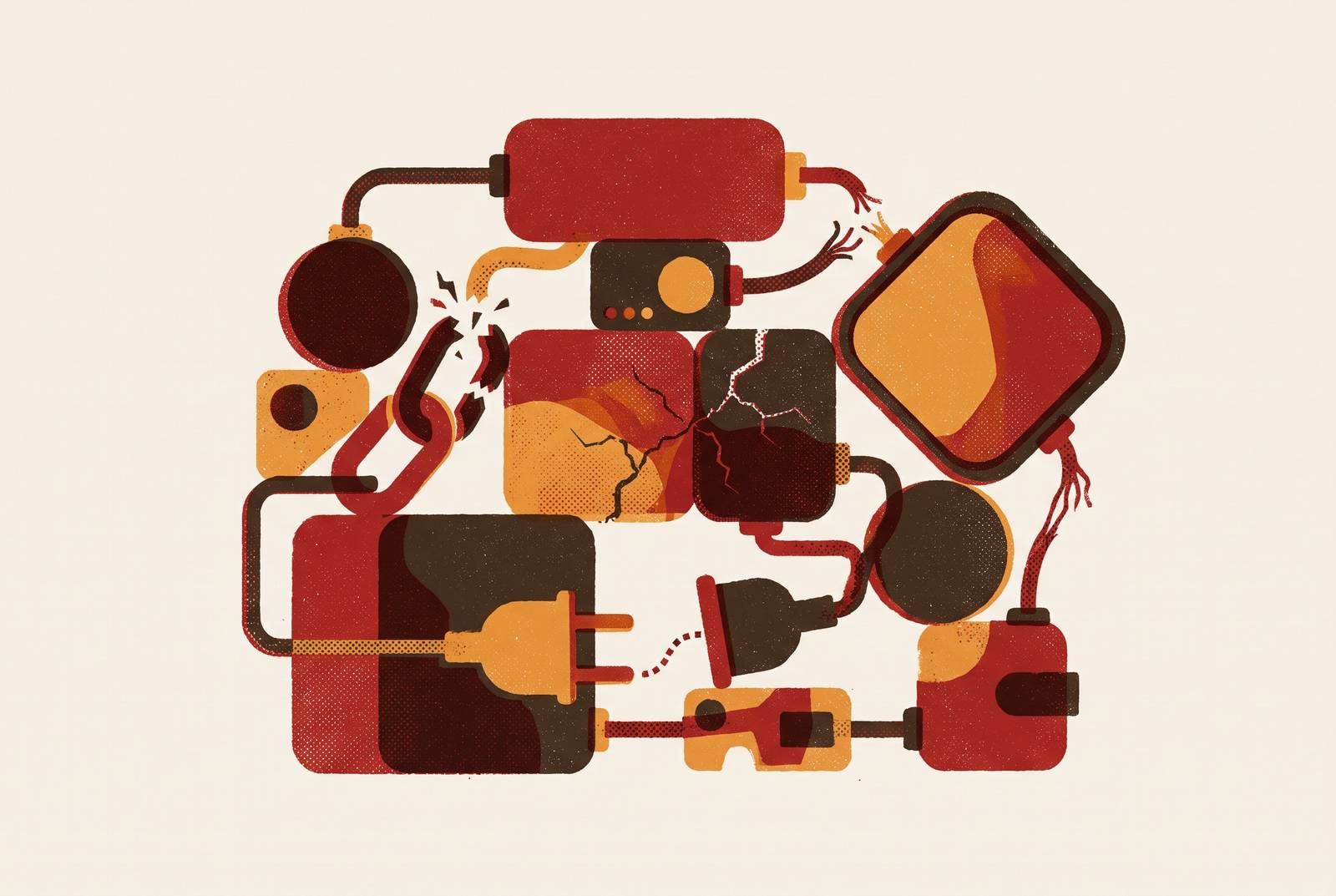
Integration fragility in multi-vendor AI tool stacks is a structural problem. Reliability depends on how data and decisions pass between systems, yet piecemeal adoption leaves those handoffs without a coherent design. As production workflows rely on more tools, their weakest seams put the work at risk in ways that better models alone cannot fix.
Why piecemeal AI adoption creates structural seams, not just tool clutter
A tooling problem concerns what a product can do, while a structural problem concerns what happens between products. Each vendor builds its AI to work within its own boundary. One tool can search a system but cannot see information held elsewhere unless access has been designed. A question that spans those boundaries therefore requires something no individual tool supplies on its own.
That gap becomes consequential when enterprise AI moves from experimentation into production dependency. AvePoint's 2026 analysis draws the distinction plainly, treating lost access during experimentation as an inconvenience and lost access during production as an outage. A workflow can now depend on a handoff that no vendor owns end to end, with no clear recovery plan when it breaks. The workflow needs to be designed around the information it needs.
How integration debt accumulates as each new tool adds another load-bearing seam
Every additional tool brings obligations as well as capability, including an API connection, a data pipeline, an SSO integration, and a monitoring arrangement. These connections must be maintained as vendors change their products. An upstream API change can break every downstream workflow that depends on it. The new tool therefore adds a load-bearing seam to an existing chain of dependencies.
Over time, engineers spend more time on glue code and less on the business results the tools were meant to deliver. Security reviews, compliance audits, and data processing agreements add another form of debt, because they scale with vendor relationships rather than with the value those relationships produce. The NexGen case illustrates how difficult accumulated dependencies become to unwind. Migration away from a closed-ecosystem vendor consumed three months of engineering time, during which several customer-facing AI features were degraded or unavailable.
Where the seams actually fail: the four layers where handoffs break down
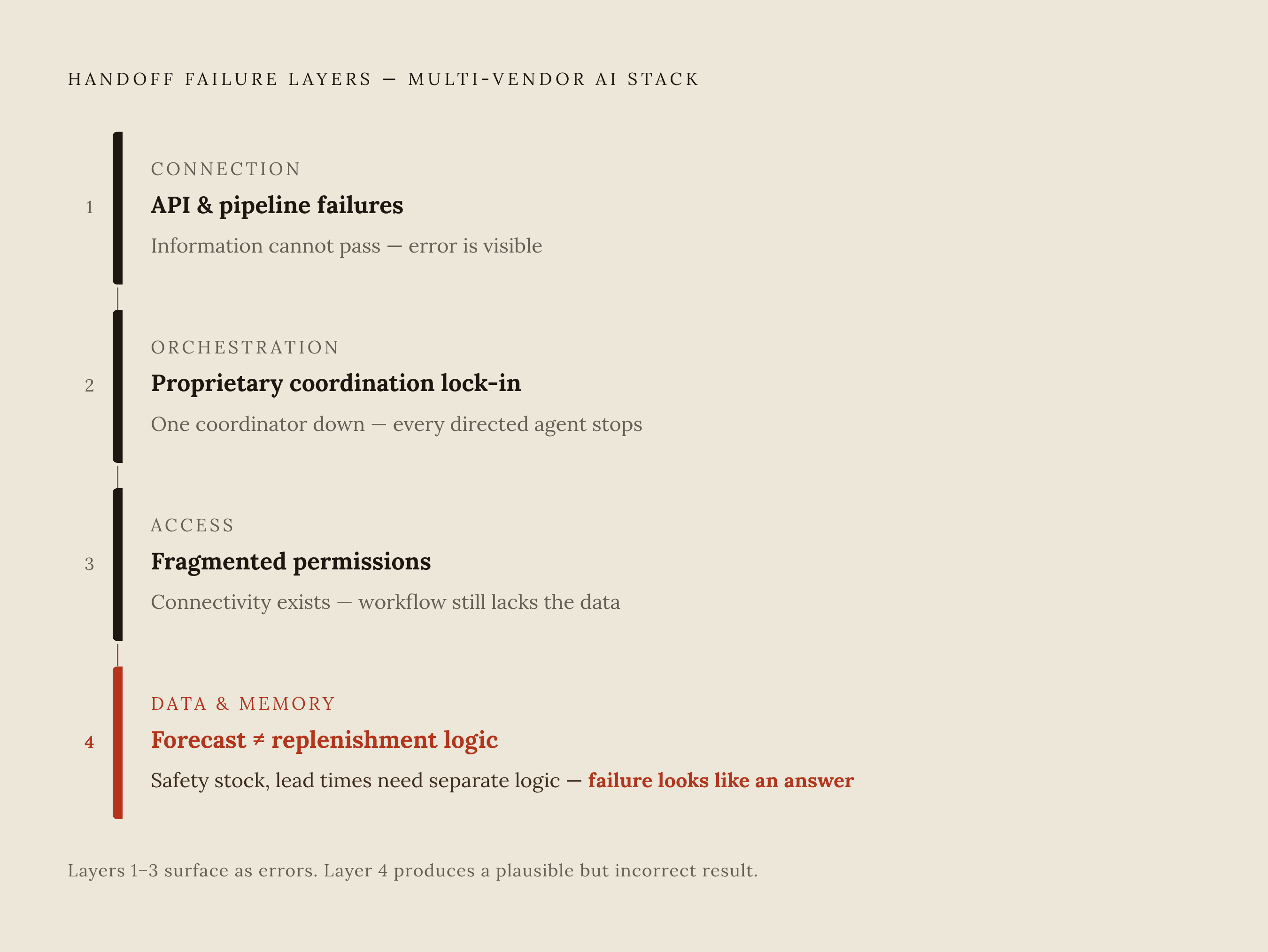
The connection layer is the most visible place to begin diagnosis. API connections and data pipelines carry information between tools, so an upstream change can break the workflows downstream. This failure concerns whether information can pass at all. Here, the model may never get the input it needs to do its task, which differs from getting that input and producing a poor answer.
At the orchestration layer, agents coordinate their work once they have connections. Proprietary orchestration can make it harder and harder to switch, while a coordinator that is down can stop every agent it directs. Multi-agent versions can also underperform a single agent using the same model on sequential or bounded tasks. That contrast points to how agents coordinate and how workflows are designed, even with the same model capability, though tasks that are genuinely parallelizable can benefit from multiple agents.
Access forms a separate layer because connectivity does not establish what an agent is permitted to reach. AI systems need secure access to every source they are expected to reason over, and that access is often fragmented across vendors. A connection may therefore exist without giving the workflow the information it needs.
At the data and memory layer, the information at hand must fit the decision the operation needs to make. A demand forecast is not replenishment logic. Safety stock, supplier lead times, and other operational variables need their own logic before a prediction can guide action. This is where a technically connected stack can still fail the work it serves.
Why the data layer failure is hardest to see and most expensive to ignore
A broken API surfaces as an error, but a data-layer failure can produce an answer that looks plausible. The model may be operating on context that does not match field conditions. The system appears to work while the basis for its decision is wrong. Automation then spreads that mismatch to more decisions before the problem behind it comes to light.
Official process documentation is one source of this mismatch. Warehouse workers, procurement buyers, and port dispatchers routinely use unwritten workarounds that enterprise software does not capture. When automation follows the documented procedure, it can conflict with the work people actually perform, prompting staff to bypass it. In construction and logistics, that gap cannot be removed through data cleaning alone because it reflects process design. Poor data in this setting does more than constrain performance, delivering flawed outputs at scale and making correction more costly than the original process failure.
In procurement, information remains in siloed systems, while the AI is expected to reason across them. If secure access is incomplete or poorly maintained, the model's apparent view of the operation is narrower than the decision requires. Reliable reasoning therefore depends on both the content of the data and the boundaries around it.
What field evidence shows about where multi-vendor stacks actually stall in construction, logistics, and manufacturing
P6 schedules and similar tools capture intent, but achievability also depends on procurement, coordination, and commissioning information held elsewhere. The infrastructure contractor deploying schedule risk monitoring illustrates this integration problem. Even when the AI monitors a schedule, it still needs access to the separate systems that hold information on delivery risks. The information must be trusted and connected well enough to support the job.
Integration with legacy systems is the most cited frustration in logistics AI adoption, followed by inconsistent data quality. Those problems meet where an automated model follows the manual but cannot account for unwritten workarounds. A pilot can therefore perform under controlled conditions and stall when connected to the actual operation. The failure appears at deployment, but its cause lies in the process the system was built to represent.
McKinsey's November 2025 analysis documents Jubilant Ingrevia's combination of AI deployment, digital infrastructure modernization, and a structured skills transformation program. Meaningful operational improvement involved those elements together. The case does not compare the outcome with AI-only deployments at comparable facilities, so it cannot establish that comparison.
Why vendor consolidation solves the cost problem but not the seam problem
Consolidation is a rational response to a real burden. Too many vendor relationships create procurement overhead, security review fatigue, and maintenance work that consumes engineering capacity. Reducing their number can reduce those costs and simplify responsibility. The objection to consolidation is therefore not that fewer vendors offer no benefit. It is that fewer vendors do not necessarily produce a better-designed workflow.
A consolidated architecture relocates dependencies and can concentrate them at a single point of failure. AvePoint's 2026 analysis describes a mid-2026 episode in which a major AI model was ordered offline under export-control authority days after launch. Organizations built entirely around that provider had no fallback while the restriction was in effect. Consolidation cannot substitute for an independent contingency plan.
The same concentration also makes exit harder as more context, fine-tuning, and institutional knowledge accumulate inside a platform. This data gravity means the organization becomes more dependent as its investment grows. Procurement may have cut the number of suppliers while leaving the way decisions cross system boundaries unchanged. The seam remains, but more of the operation now rests on it.
Why governance applied uniformly across agents makes the seam problem worse
Uniform governance appears to offer a way to control those dependencies, but it can obscure the distinctions that matter. An agent's ability to act is different from the scope of access it is granted. A low-autonomy summarization tool and a high-autonomy agent acting in production systems do not present the same integration problem. Applying identical rules can over-restrict a capable agent or grant a narrow one access it should not have.
Multi-vendor stacks make this mismatch harder to resolve because vendors define autonomy and tool access differently. A rule for the whole organization can miss those differences where agents work with systems. Governance then becomes either a bottleneck that constrains every agent to the most restrictive arrangement or a formality too coarse to be useful in practice. Neither outcome clarifies the handoff between permission and action. Governance must therefore be part of integration design rather than a uniform layer placed over a finished stack.
What standardization must precede automation — and why process auditing is the missing step
A reliable design first requires a process that can be described precisely. An agent cannot execute consistently when the workflow depends on implicit human judgment that no tool has been designed to handle. Standardization must precede automation, but standardization cannot mean accepting the official procedure without examining it. Otherwise, the organization gives a precise description of the wrong process. The unresolved gap then reappears as an integration failure.
A process audit establishes how work runs today, where handoffs happen, where workarounds live, and where data actually comes from. The purpose is to expose places where a supposedly clean handoff depends on someone supplying missing context or resolving ambiguity. Those are process-design problems before they are connection problems. They must be understood before deciding what to automate or which tool to add.
Procurement makes the sequence particularly clear. Secure access to the sources an agent must reason over needs to be designed before the agent is built. The audit therefore defines the conditions the integration must satisfy, rather than serving as documentation for a tool choice already made.
How to design for reliable handoffs rather than patching the ones that break
A reliable architecture is built around how data and decisions move, with the available tools fitted to that plan. This changes the unit of design from an individual capability to the handoff that makes it useful. A prediction must connect to operational logic, and an agent's permissions must match both its autonomy and its task. Each boundary needs to reflect the production process rather than the simplified conditions of a demonstration.
Reliability also requires fallback paths that have been exercised before an interruption. AvePoint's 2026 analysis recommends testing the fallback before it is needed and distinguishes vendor safety messaging from an organization's own contingency plan. A multi-model strategy that has never been activated is not a tested recovery path. The same design discipline applies to governance, with autonomy and access decided before deployment.
Work should start with one painful process that can be understood precisely. Resolving its real handoffs produces more durable learning than a multi-process roadmap that never reaches production. The process audit is therefore not preliminary work to finish before integration begins. It is the work that reveals what the integration must do and where it is most likely to fail. Teams move beyond patching when they begin with that single process and design its seams around how the operation actually runs.