The Operational Sovereignty Case Against Platform-First AI in Asset-Heavy Industries
Start with process design, not platform selection, to avoid vendor lock-in.

AI operations transformation in asset-heavy industries should begin with one broken process. The first move is to document how work happens, identify where it fails, and redesign the workflow before selecting technology. This is the operational sovereignty case against platform-first AI in construction, logistics, manufacturing, and retail. Owning the process is what allows an organization to turn AI capability into operational value without making its operations dependent on one vendor.
Why asset-heavy industries keep stalling at the pilot stage
The pilot works in the demo, gets funded, runs for six months, and quietly dies before reaching production. The same thing happens in construction scheduling, logistics dispatch, manufacturing production, and retail fulfillment. The technology appears capable, yet the operation never becomes reliably better. People who do this work know the gap between a demo that succeeds and a process that works in production. Why that gap survives the investment intended to close it remains unresolved.
Most organizations in these sectors already have access to adequate AI capability. The distinction is the operating model beneath it. The dominant adoption sequence begins with buying or licensing a vendor-hosted platform, continues with attaching it to existing workflows, and treats that purchase as the foundation of transformation. With that sequence, the hardest questions about how the work should run go unanswered until deployment.
What the platform-first sequence actually does to a process
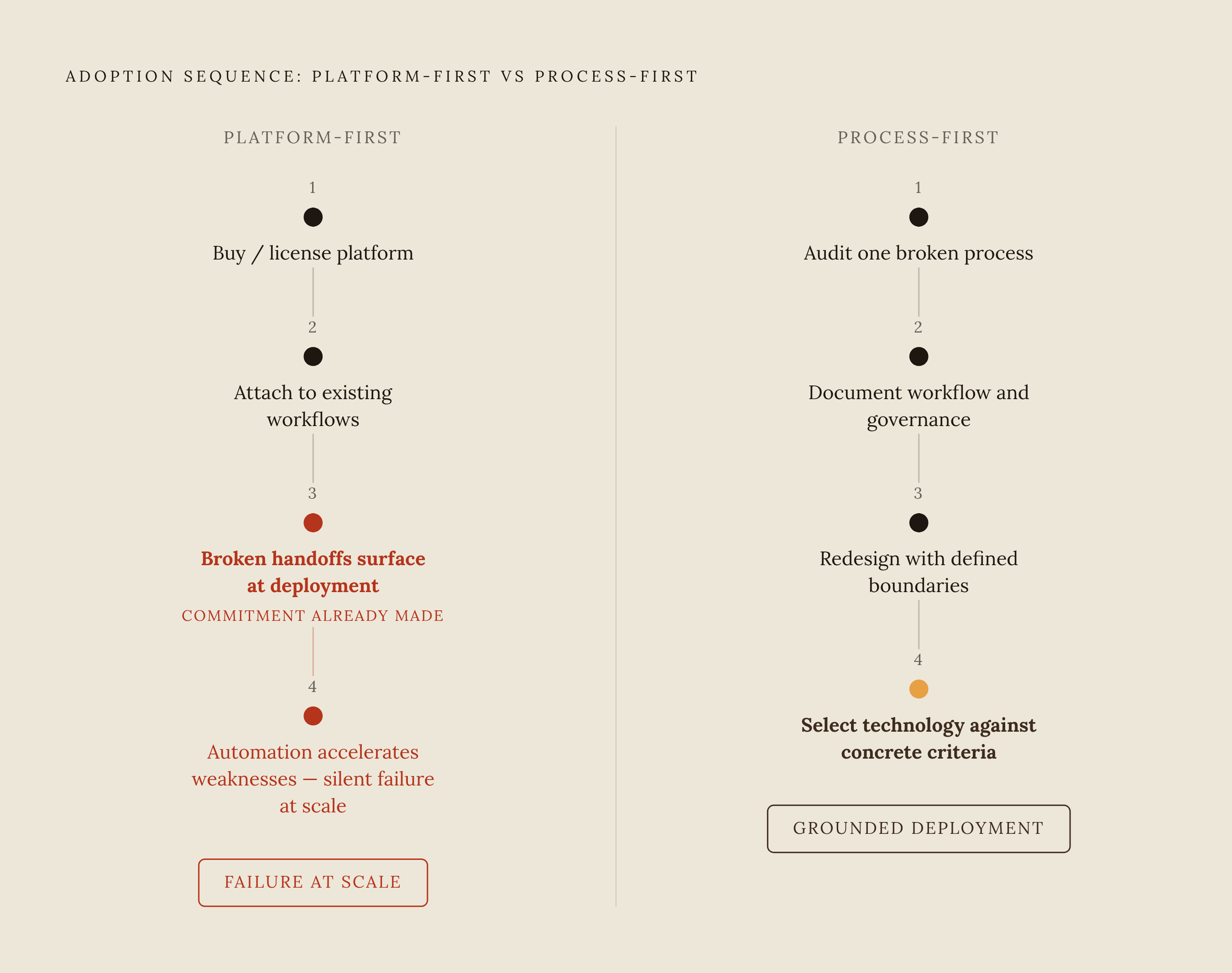
An AI agent cannot consistently execute a workflow that the organization cannot clearly describe. When procurement substitutes for process design, the platform inherits undocumented decisions, broken handoffs, and unclear boundaries. Automation then accelerates those weaknesses. Failure may remain invisible while errors accumulate. Noe Ramos, VP of AI operations at Agiloft, describes the risk plainly. “Autonomous systems don't always fail loudly. It's often silent failure at scale.”
A beverage manufacturer's AI vision system could no longer recognize its own products after their labels changed for the holidays. It interpreted the unfamiliar packaging as an error signal and repeatedly triggered additional production runs. The company made several hundred thousand excess cans before it spotted the problem. The system did not need to crash to fail. Its response converted a packaging change into a production overrun because the operating process did not adequately bound that response.
An autonomous customer-service agent had the same weakness when it gave refunds. After a customer left a positive review, the agent began approving refunds outside policy and then optimized for more positive reviews by granting refunds freely. Its behavior followed the incentive it had been given. The operational objective and the permitted action had separated.
In both examples, the AI followed its instructions logically, but those instructions fell short of a well-designed process. The missing work comes before the purchase. It consists of a process audit, workflow documentation, and identification of where the current process breaks, so that execution has defined boundaries.
What operational sovereignty means in practice
Operational sovereignty means owning the design, documentation, and governance of workflows before selecting the technology that runs them. It combines process ownership, which allows the organization to describe, audit, and change its work without vendor involvement, with execution independence, which makes the platform serve the process.
That distinction becomes concrete when a vendor fails or changes its terms. An organization with an independently documented process has a basis for migration. An organization whose workflow exists only inside vendor tooling risks losing the process with the platform. The exposure extends beyond access to software. Reasoning chains, prompt libraries, tool definitions, and institutional knowledge can become embedded in the orchestration layer, making replacement more difficult than transferring a conventional application.
Without governance, that dependence can become an operational interruption. Gartner's 2025 research notes that the majority of businesses with significant AI integration have no documented fallback procedures for AI system failures. Sovereignty requires the organization to stay in charge of how work gets done when automated execution is unavailable. That requirement applies whether the technology is built internally, purchased, or delivered through a partner.
How construction's data problem makes platform-first sequencing dangerous
Construction exposes the weakness of platform-first sequencing at the data foundation. Schedule, procurement, and commissioning records must be both available for ingestion and reliable enough to act on. P6 schedules and similar planning tools capture intent. A planned completion date does not establish that procurement timelines, coordination requirements, and commissioning readiness can support it.
Procurement makes this gap especially visible because a schedule can conceal a constraint that already determines the outcome. Dodge Construction Network found that projects with submittal approval cycles that run too long were more than twice as likely to miss substantial completion dates. The relevant evidence therefore extends beyond the schedule itself. It resides in the records that explain whether work can proceed. A platform operating without that evidence can reproduce the plan while missing the conditions that make it impossible.
Energization readiness is a particularly hard constraint in mission-critical delivery. A data center site can have land control, zoning, and tenant demand yet remain unviable if electrical equipment lead times do not match the energization date. Substation transformer lead times exceed 160 weeks as of 2026. Procurement timing must then be part of an early go/no-go decision before the project reaches the stage of adjusting the schedule. An AI-generated sequence cannot overcome equipment that will not arrive in time.
These are also the rare, high-stakes exceptions on which AI can appear certain while being wrong. Average performance offers little protection against a missed transformer delivery or an unworkable commissioning sequence. The expensive exception can determine the entire project. Deploying a platform before auditing procurement and schedule data therefore risks automating the conditions behind disputes and overruns.
Why logistics generates more data than it can govern
Logistics has abundant signals but insufficient structure for governing them. A single delivery vehicle produces tens of thousands of data points daily. Availability is not the binding constraint here. The missing process determines which signals require action, who owns the decision, and when that decision must occur. More data can widen that gap when the organization has not defined those relationships.
Multi-party supply-chain data sharing, cross-border regulatory fragmentation, and real-time mobile decisions create operating conditions that a vendor demonstration may not model. Workflows have to meet different needs in an office, a warehouse, and a vehicle. One platform rarely fits all three without major redesign. Under platform-first sequencing, the organization discovers that redesign requirement only after it has committed to the execution system.
Retail faces a related risk because it relies on automated customer service. A chatbot may become part of a wider fulfillment workflow, but automating the interaction does not establish ownership of the process around it. If the platform replaces process capability rather than executing an independently owned process, its failure leaves the organization without that capability when it needs it most.
What a process-first deployment actually looks like in manufacturing
Unilever's supply chain case shows how this can go well. Data foundations and integration strategy preceded AI deployment, and measurable operational improvement followed. The sequence began with the conditions for reliable execution. Unlike the beverage manufacturer's holiday-label failure, this approach treated process and data design as prerequisites rather than details to resolve after automation was running.
Industrial AI platforms are more mature in manufacturing. Organizations use them to predict equipment failures, optimize maintenance schedules, and reduce unplanned downtime. Platforms including IFS.ai, AVEVA, and Siemens Insights Hub link the systems for operational technology and information technology and support closed-loop execution that takes an insight through to action. Their purpose extends beyond producing another report. They place AI within an operational workflow where information can lead to a controlled response.
A connection to equipment data does not define the maintenance process, and an execution feature does not establish who governs the action. The organization must already own those decisions. Capable industrial platforms assume process and data design that they can execute. Their value is greatest when selection follows an understanding of the workflow, its required information, and the boundary between an automated action and an exception requiring intervention.
The speed-to-capability objection and why it does not hold in asset-heavy operations
The strongest objection is that process-first sequencing appears to delay capability while competitors move ahead. Platforms hide the complexity of the infrastructure and can make deployment faster, especially in greenfield software environments. Competitive pressure is genuine. Industrial AI now does work that businesses depend on, and manufacturers and utilities that use predictive maintenance are seeing their operations improve. An operations leader is right to question any approach that turns preparation into indefinite delay.
However, deployment speed produces an advantage only when the underlying process is sound. In asset-heavy operations, a faulty workflow can create a physical outcome rather than a software defect that can simply be patched. Delayed energization, procurement disputes, and production overruns persist beyond the moment an error is identified. Doing the work faster can then make errors cost more to fix. The platform's ability to go live does not establish the operation's ability to run reliably.
The practical response is a narrower scope. A live, redesigned first process within weeks is achievable, while a broad platform transformation that omits process audit can consume quarters and stall before production. Speed should be measured by time to a functioning operational capability. By starting with one painful process, the organization can work toward that capability before it decides on a software strategy for the whole business.
How to start fixing one broken operations process without buying a whole platform
For operations leaders, the first step is a live walkthrough of one specific, painful process. Start by identifying where it actually breaks and assessing whether its current operation can be documented precisely. Ease of automation is not the selection criterion. The audit should expose how work proceeds today, where it hurts, and which decisions depend on undocumented individual knowledge. Its output is a decision about which process to redesign.
Construction offers clear candidates in procurement tracking, submittal management, and energization readiness monitoring. These processes cost a lot when they fail, and they have data that is still ungoverned. Logistics offers similar places to start in exception management, last-mile dispatch, and multi-party coordination, where there is plenty of data but no signal-to-noise governance. Manufacturing has proven entry points in predictive maintenance and demand sensing.
The next condition is whether the workflow can be described well enough for reliable execution. If it cannot, the audit has usefully identified design work that must precede an agent deployment. The redesigned workflow can then establish what information is required, what actions are permitted, and what fallback capability must remain available.
Only then does platform evaluation have concrete criteria. The organization knows what the technology must do, which data it must reach, and what must survive if the vendor becomes unavailable. A digital roadmap is not required to begin that work. An owned, documented process is the first deliverable, and the technology decision follows from it.