The Operational Decisions Logistics Companies Can't Delegate to AI Until They've Audited the Process Underneath
Audit your workflows before handing decisions to AI systems.
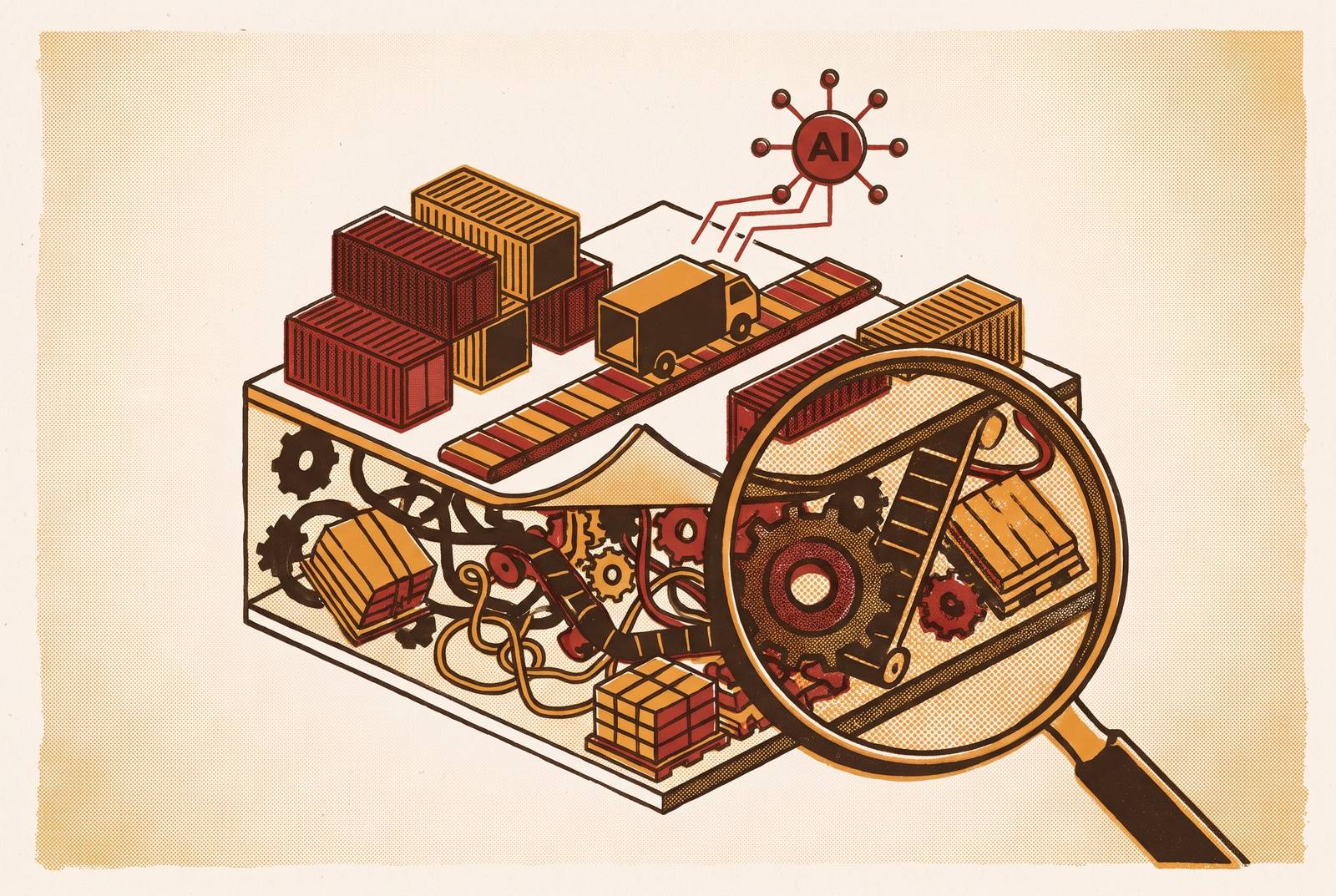
Before construction and logistics companies hand operational decisions to AI, they must audit each workflow to check that they can describe, measure, and control it. That means checking data quality, recorded inputs, exception rules, decision records, and ownership. AI executes the process it receives rather than repairing its weaknesses, so the safest starting point is a bounded decision whose performance can be verified.
Why AI in logistics executes processes rather than corrects them
Most AI projects reach production, but far fewer share results that can be measured. Operational improvement depends on the business defining the decision the system is supposed to execute and establishing how its result will be judged, alongside model capability.
Route optimization, dispatch, exception management, and demand forecasting all use decision logic to do their work. They do not relieve the operator of defining sound rules. If those rules depend on incomplete records or undocumented judgment, automation accelerates that dependency.
The data foundation is part of that logic. A dispatch decision based on unreliable GPS records or incomplete inventory information lacks a dependable account of the operation it is directing. A better model leaves those records as they are. Making and checking the decision requires reliable information from the process, even when an AI system can generate an answer.
The strongest objection is that waiting for perfect documentation would defer adoption indefinitely. No large logistics operation achieves complete data cleanliness simply by requiring it. A team needs to audit enough of a particular workflow to describe its rules, measure its results, and control its exceptions. The describable parts can then move into delegation while less understood decisions remain with people.
What should a logistics company audit before implementing AI automation tools?
A process audit investigates whether a workflow is precise enough for an AI agent to execute without inventing its own rules. A data quality review is narrower. It can establish whether a field is complete without establishing who acts on it, which exceptions change the decision, or whether the resulting action can be reconstructed. The working standard is a process that can be described, measured, and rebuilt from its records.
First, check whether data is complete and consistently normalized at entry, or whether experienced staff fill gaps informally. Any model will be less reliable if it uses TMS data with gaps, GPS records it cannot trust, or inventory tracking that is inconsistent. The second question concerns exceptions. Port strikes, border closures, carrier failures, and late proof-of-delivery need identifiable conditions and response rules if an agent is expected to handle them. Otherwise, the apparent workflow omits the judgment that makes it function.
Third, test whether the process can be re-executed from its own records. An audit trail that stops at a consequential decision cannot support that test. Fourth, establish who is responsible for each decision and who can override it. Together, these questions distinguish a documented sequence of tasks from an operational process whose decisions can be verified.
Kyanon Digital’s case study for Vietnam’s largest port and logistics operator describes a scalable data hub, a centralized reference data catalog, and AI-powered BI dashboards. The data hub and catalog illustrate the foundation on which AI-ready operations depend. Governance needs an equally deliberate foundation. Locus’s 2026 governance analysis identifies six architectural mechanisms, including explainability, traceability, evaluation, autonomy levels, execution sandbox, and human-in-the-loop. These belong in the design of the workflow, because feature-level governance can leave gaps in the records when incidents happen, while architectural governance keeps producing evidence.
The regulatory environment that makes governance gaps costly rather than merely inconvenient
European regulation makes it especially clear what those gaps can cost. The governance logic extends beyond operations in that region, however, because any organization delegating consequential decisions needs to establish what happened and who was responsible. Europe is a leading indicator of that requirement. Routing, dispatch, capacity allocation, exception management, and customer communication can all raise governance questions within ordinary daily work, rather than only in unusual or experimental applications.
Locus identifies four converging frameworks relevant to autonomous logistics decisioning. The EU AI Act entered application in stages from 2024, with high-risk provisions taking effect from December 2027 for Annex III and August 2028 for Annex I. For the systems it covers, it calls for documentation, transparency, accuracy, and human oversight. The CSRD’s implementation runs through 2025–2028, including Omnibus revisions, and brings audit-trail requirements for sustainability reporting and disclosures. GDPR Article 22 governs automated decisions affecting individuals, while another regulatory framework adds operational continuity requirements with increasingly cross-sector implications.
These frameworks do not make every logistics decision subject to identical obligations. Nevertheless, they expose a common weakness in undocumented automation, because an operational explanation is not necessarily evidence. A business may explain why it chose a route yet lack an ongoing record of the inputs, reasoning path, and effects on the operation that it needs when the decision is checked.
If an AI incident cannot be attributed to a responsible unit or contractual owner, the organization lacks a defensible answer for a regulator or counterparty. Ownership cannot remain implicit after authority is delegated. The audit therefore has to establish both the evidence behind a decision and the party responsible for it, before an incident forces those questions into view.
The decisions that become delegation-ready once the underlying process is audited
Route optimization is a strong delegation candidate because its inputs are structured and observable. GPS, load, time windows, and traffic provide a concrete basis for assessing readiness. Their availability cannot simply be assumed. To pass the audit, those inputs must be recorded consistently enough to support decisions, and the operation must have a baseline against which changed performance can be assessed.
A regional distribution operator with a substantial fleet and hundreds of daily deliveries illustrates the baseline requirement. Its pre-AI delivery failure rate had to be measured before deployment was approved. Without that reference point, the business could not verify improvement. The distinction is between introducing a new way to choose routes and demonstrating that the new approach improves delivery performance.
An AI system can flag anomalies and route them to the appropriate human when the escalation rules are documented. That is not autonomous exception resolution. The delegated decision concerns whether a condition requires attention and who should receive it, rather than what commercial or operational commitment should follow. This narrower scope makes the decision easier to audit and govern.
This difference also shows why autonomy levels must be clear. A business may have enough records and rules on ownership to hand over escalation while still knowing too little about the process to hand over resolution. Readiness belongs to the individual decision. Treating exception management as a single automation category obscures that boundary and can assign more authority than the evidence supports.
Across these candidates, three properties establish the basis for delegation. Inputs are consistently recorded, exception conditions are codified, and a defined owner has authority over overrides. Those conditions connect operational reliability to governance. They also give the audit an affirmative purpose, because its result is not merely a register of deficiencies but a defensible boundary around decisions the organization can hand over.
The decisions that remain dangerous to delegate until more of the process is understood
Port strikes, natural disasters, and border closures can put an AI system in conditions it did not encounter in its training. The output may still appear confident. When the disruption is genuinely novel, the system may lack a reliable basis for its recommendation, and the organization may recognize that only after a consequential action. A documented escalation route is therefore distinct from authority to resolve the disruption.
Coordinating procurement across several parties has a different weakness. In logistics and construction, calls and emails often hold the communication, purchase orders are created by hand, and supplier information remains scattered across inboxes. Central visibility is limited. Delegating coordination before those inputs are unified can produce confident-sounding outputs based on an incomplete account of the procurement process.
Decisions on energization and materials readiness also depend on telling what the records show apart from what people assume is ready. Without real-time tracking, an AI system works from optimistic guesses. The consequences arrive after commitment. Schedule disruption, excess inventory, expediting costs, and unplanned workarounds can follow a readiness decision whose underlying information was never dependable enough to support it.
Letting a system resolve flagged risks on its own adds a safety problem in the process itself. MedAgentAudit research from Peking University and the University of Hong Kong shows that multi-agent systems can create false consensus through authority bias, evidentiary drift, and the suppression of minority views. Checking only how accurate the final output is can hide that failure. The logistics analogy is an agent synthesizing conflicting carrier, weather, and inventory signals into a confident recommendation built on compounding errors, without an audit trail revealing suppressed disagreement. The finding concerns medical systems, but the relevant lesson is to audit how agents reach agreement.
These decisions expose the capability-deployment verification gap. An agent may perform a task in controlled testing while the business cannot verify or trust its behavior against live data and proprietary systems. Capability does not establish operational control. Closing that gap depends on model quality and the process records, oversight, and governance architecture available before delegation.
How to sequence the audit so the first delegated decision goes live in weeks, not quarters
The work starts with the decision that causes the most pain, comes up most often, and already uses recorded inputs. That scope gives the audit the shortest distance to travel. Instead of investigating every workflow before permitting any deployment, the team can establish the rules, evidence, and ownership needed for one bounded decision. The objective is a live result that can be measured.
A baseline makes that result interpretable. The regional operator’s pre-AI delivery failure rate of 12% is the kind of reference needed to test whether delegation improves performance. Without it, the organization cannot confirm the change is working. Establishing the baseline is therefore part of preparing the decision for delegation, rather than a reporting task to complete after launch.
The work then follows the dependencies of the process. A team should confirm that data is consistently captured at source before evaluating a model, and standardize exception codes before delegating exception management. Each automated output also needs a named decision owner before the system is given more autonomy.
Graduated autonomy provides the release sequence. Augmentation comes first, with AI advising and a human deciding. Automation follows within set limits, with a human watching, while true autonomy must wait until the system has earned it through proven performance. The governance mechanisms identified earlier must support the first delegation. Explainability and traceability establish the evidence, while evaluation, autonomy levels, execution sandbox, and human-in-the-loop define how delegated behavior is assessed and controlled.
A timeline measured in quarters is a signal to examine scope and question the assumption that rigor requires delaying deployment beyond weeks. The better sequence is to audit one constrained workflow, delegate within its established boundaries, measure the result, and expand from there. A process audit is a prerequisite for safe delegation, but a tightly scoped audit is also what makes a fast first deployment possible.