The Single Process Fix as a Load-Bearing Test of AI Operational Fit
Testing one painful process reveals whether your organization can actually operate with AI.
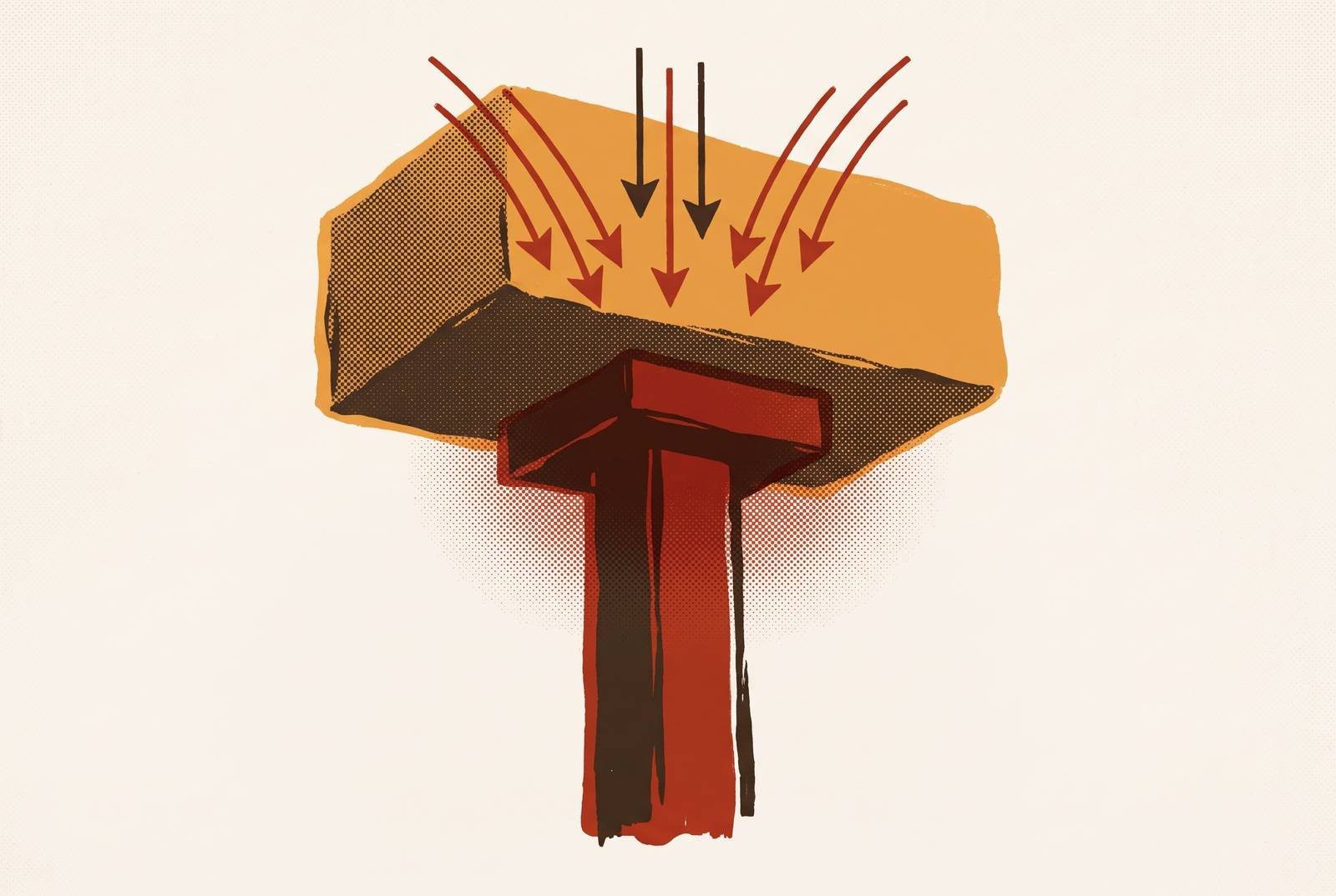
AI operations transformation in asset-heavy industries can start by rebuilding one painful, data-rich process around AI, before a platform strategy is in place. That rebuild is a load-bearing test of whether the organization’s data, decision authority, and actual workflows can support AI-first operations, and broader transformation has a sound foundation only if the production result supports it.
Why the first AI process fix is a fitness test, not a pilot
A pilot tests whether a capability can demonstrate value. A production rebuild tests whether the organization can sustain it. For practitioners who have already run successful demonstrations, that distinction explains why another promising use case may do little to advance operations. Accelerating an individual task leaves much of the surrounding workflow untouched. Rebuilding the process exposes the dependencies that a demonstration can avoid, including who supplies usable data, who authorizes action, and who resolves exceptions.
Deloitte’s AI in Manufacturing 2026 survey reports that 84% of manufacturers already get value from AI that they can measure, but only a small fraction of use cases have scaled. Value alone is therefore an insufficient test. The gap between task-level improvement and end-to-end transformation is not simply a difference in ambition or tooling. It reflects what the operating environment can support beyond a bounded demonstration. The first rebuild puts that environment under load, making its ability to sustain and replicate the improvement part of the result.
What "operational fitness" actually means and why most organizations don't have it
Operational fitness requires process signals that are dense and clean enough for AI to act on, clear decision authority, and workflows that match actual execution. These conditions often remain implicit in established operations. People fill gaps in records, know when a decision needs approval, and find ways to work when the written procedure does not fit the situation. An AI-first workflow makes those accommodations explicit dependencies. The organization must know not only what information exists, but also what decisions it supports and where authority changes hands.
Tacit knowledge is the hardest dependency to expose. Process documentation and system flows rarely cover every informal escalation path, judgment call that people make time and again, or rule for handling exceptions. A redesign based on those records alone can look complete while omitting the logic that keeps the work moving. Interviews with the people performing the process reveal what the formal map leaves out. Without that knowledge, an agent encounters an operational problem that its designers have treated as already resolved.
The electrification parallel clarifies why this is a structural issue. Factories that plugged electric motors into steam-era layouts gained little of the productivity they could have gained because the layout was still built around steam. Getting that gain took a redesign as well as access to electricity. Similarly, a generic AI tool may be useful without being transformative when it lacks the context of a plant’s equipment, operators, supplier relationships, and quality thresholds. A scrap-reduction approach that fits one facility may be irrelevant or risky in another.
Where process signals are dense enough to make the test meaningful
The most revealing process combines concentrated pain, usable signals, a measurable outcome, and clear operational ownership. Strategic visibility is not an adequate substitute. In manufacturing, Quality, Production, and Logistics/Supply Chain have strong traction because machines, sensors, and process control environments provide data tied directly to operational results. The Deloitte survey places Quality adoption at 62%. These domains offer a clearer connection between the intervention and its effect than fragmented support functions where responsibility and evidence are dispersed.
A process with high data density can still be complex. AI can often do the most in variable, hard-to-control processes where more parameters affect each other than people can reliably assess. The same survey identifies chemical/physical transformation as the highest-potential area for process manufacturing, and assembly and primary shaping as the leading areas for discrete manufacturing. The selection principle is therefore not to find the simplest task. It is to find a difficult process whose conditions and results are sufficiently legible to support intervention.
In logistics, the shift is from dashboards toward execution, with AI moving beyond reporting events to orchestrating subsequent work. IT support ticket triage provides a compact example of this process anatomy. Incoming requests are classified, routed to the correct team, and supported with resolution steps from historical cases within the existing service environment. Each stage has a defined operational purpose. That makes the rebuild more specific than a broad commitment to improve service through AI.
The stakes are higher in construction because scheduling, procurement sequencing, and energization readiness link each package to how the whole facility turns out. Long lead times for major equipment mean that a delay in one package can stall commissioning. A declared plan is not field evidence. The fitness test must therefore check whether the workflow matches what practitioners can see on site, beyond whether AI can produce a schedule that makes sense. Across these sectors, the strongest candidate is a painful process with enough evidence to distinguish a real operational improvement from a persuasive demonstration.
What the first rebuild actually tests: the four structural questions it forces
The first question concerns data usability. The rebuild shows whether the signals stored in the organization are up to date, structured, and dense enough to act on. Availability is not the same as usability. The Deloitte survey identifies data availability or quality issues as an implementation barrier cited by 30% of respondents. In a live workflow, that distinction becomes concrete because the agent either has the information required for its next decision or cannot proceed reliably.
The second question concerns decision authority. At each step, the process must distinguish between an agent acting, recommending an action, and escalating to a person. Policy alone does not establish that boundary. Treating access as a binary choice between restriction and full trust can over-restrict a simple agent while leaving a more autonomous one under-restricted. The rebuild shows whether the organization's stated authority is built into the workflow at the points where decisions are made.
An agent built around the documented process encounters failures when actual work depends on informal paths and unmapped judgment. Those failures are specific enough to expose missing logic within days. Construction makes this discrepancy particularly visible. Reporting is project managers’ leading AI priority, yet trust in accuracy is the largest adoption barrier because practitioners will not act on a generated plan without comparing it with observable site conditions. The test is whether the process represents the work.
Real access tests whether the organization can monitor, audit, and correct an agent after it leaves the demonstration environment. Five recurring failure modes define the task. They include governance gaps that permit actions outside policy, transparency gaps that prevent reconstruction of actions, coordination gaps between agents, safety gaps where untrusted content contaminates trusted reasoning, and improvement that plateaus despite model upgrades. Reliability also depends on the layers around the model, including tool chains, prompt changes, provider routing, evaluation pipelines, traces, and behavioral drift. A model demonstration that works does not prove that those layers are under control.
How do organizations fix one broken operations process without buying a whole platform?
A process should be selected by its operational boundaries. A suitable first workflow has specific, attributable pain, existing usable data, decision logic that can be made explicit, and a directly measurable output. Leadership visibility is a weaker criterion. For a plant without a digital roadmap, this makes selection a question of evidence and ownership rather than an early commitment to enterprise architecture.
That discipline begins with the people performing the work. Workflow discovery maps where manual effort accumulates and identifies judgments that recur often enough to become explicit decision rules. Those rules precede agent construction. This answers the earlier questions about authority and fidelity together, because it establishes both what a decision requires and who is entitled to make it. Widening the scope during this work weakens the test because it replaces one well-defined problem in the work with several that are only partly understood.
P&G’s documented outcome at the 2026 Gartner Supply Chain Symposium/Xpo illustrates the distinction between adding AI to roles and redesigning work around it. P&G streamlined from 35 processes to 20 while creating two new planning roles, supply flow analyst and supply flow engineer. The role design changed with the process design. This example does not establish a universal deployment method or prove that every organization needs the same roles. It shows that operational redesign can change both the number of processes and the responsibilities needed to run them.
Scope also determines the speed of useful evidence. The single-workflow discipline aims for measurable productivity gains within a 90-day window, rather than dispersing effort across simultaneous use cases. The deadline is an operational constraint. A first process that spends quarters outside production leaves the organization’s inertia largely untested, however much model development occurs. Moving from discovery to live execution without broadening the assignment is what exposes whether the proposed workflow can function under real conditions.
What a failed first rebuild tells you, and why that is also valuable information
A failed rebuild identifies a missing operational property rather than establishing that AI is categorically unsuitable. Data may be unusable, authority unresolved, the workflow map inaccurate, or production governance inadequate. The distinction changes the next decision. Instead of commissioning another demonstration, the organization has a specific explanation for why the process cannot yet sustain AI-first execution. Demo-level success postpones that explanation, allowing the same weakness to emerge later with greater cost and less traceable causes.
That information does not make every test low-risk. In construction, an agent that disrupts scheduling or procurement without clear governance can trigger energization delays, commissioning stalls, and contract penalties. Consequences extend beyond the AI deployment itself. Less mature governance thus makes the choice of a mission-critical process riskier, even when the pain is concentrated in that process and its outcomes can be measured. A thorough fitness test must account for that risk, even when its scope is small.
Competitive pressure does not remove these dependencies. Running several deployments simultaneously can multiply demo-to-production failures when the organization has not developed monitoring, audit, and correction capabilities through a live process. Breadth then spreads an unresolved weakness across functions. Depth on one workflow offers a faster route to precise information about what blocks production and what must change before expansion. No audit or roadmap produces that evidence as reliably at the same cost and speed, which makes a live process test an exacting exercise of operational leadership.
What the first process result determines about everything that follows
A positive result must establish more than local task acceleration. It must show that the rebuilt workflow performs in production and that the organization can sustain the data, authority, and controls behind it. Choosing a platform alone cannot put those conditions in place. The Deloitte survey identifies robust data, governance, and deployment models as requirements for moving from pilots to enterprise-wide operations. Their practical adequacy becomes visible through production work.
In asset-heavy, process-intensive industries, each rebuild that works can improve the operating context for the next one. Better data habits, stronger governance reflexes, and greater trust in AI-generated outputs can help with work beyond the first workflow. Expansion is conditional on those gains being real. A failed test gives the organization no basis to assume that the next process can safely draw on capabilities it has yet to prove.
The electrification parallel ends with system design. Durable advantage came from reorganizing work around a new capability. For AI, the first production rebuild is where that distinction becomes observable. Operations leaders should choose the first process for what it will reveal.