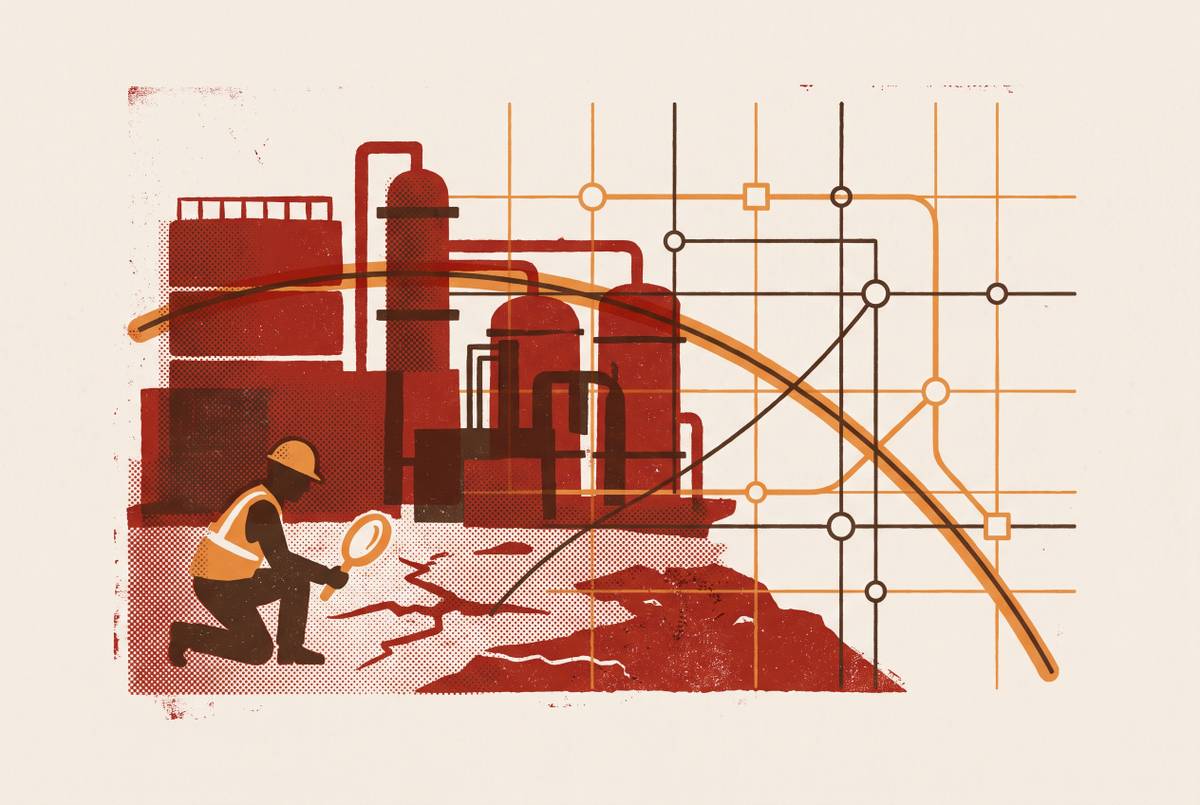
Process Debt in Capital-Intensive Operations and Its AI Costs
Unmachined workflows and siloed data are costing AI deployments far more than the technology itself.

The most expensive problem in AI deployment is not the technology. It is the accumulated weight of workflows that were never designed to be executed by anything other than human judgment, phone calls, and institutional memory. That weight has a name: process debt. In capital-intensive operations, where physical assets, long lead times, and multi-party coordination govern every outcome, process debt determines whether AI becomes a competitive advantage or a faster route to the same failures.
What process debt actually is and why capital-intensive operations accumulate it fastest
Process debt is what you owe when workflows were never built for machine execution, autonomous decision-making, or high-stakes sequencing. It is distinct from technical debt, which lives in code and system architecture. Process debt is in how work is sequenced, handed off, and governed. A procurement coordinator who keeps a personal spreadsheet because the ERP cannot be trusted is carrying process debt. A scheduler who knows the P6 plan is fiction but publishes it anyway is carrying process debt. A project manager who spends three days on the phone reconciling vendor status reports has process debt. The systems work. The process does not.
Capital-intensive sectors are the worst hosts for this condition. Construction, logistics, manufacturing, and data center development share the conditions that generate process debt fastest: fragmented handoffs across contractors and vendors, long-lead physical dependencies, manual coordination layered over ERP systems that were never integrated, and governance structures that evolved reactively rather than by design. Each of these conditions compounds the others. A fragmented handoff becomes more costly when the item being handed off is a transformer with an 18-month lead time. A governance structure that evolved to handle last decade's project volume becomes a liability when the schedule compresses.
The standardization gap sits at the core of the problem. A process that cannot be clearly described and documented cannot be reliably executed by an AI agent. In most capital-intensive operations, the process exists only in the heads of experienced coordinators. It is tacit knowledge passed through apprenticeship and hard-won experience. No document captures why the permitting package gets reviewed in a particular order, or which vendor's lead times can be trusted and which cannot. That knowledge is real, and it is operationally load-bearing. It is also completely unmachine-able.
Data fragmentation functions as a tax on everything built on top of it. Enterprises in these sectors typically run on a large number of applications, the majority of which cannot interface with one another. An agent meant to work across systems hits a wall of siloed, incompatible data right away. The 2025 Deloitte AI study found that 35% of organizational leaders identified legacy system integration as the most significant barrier to scaling AI efforts. That figure describes the symptom. The disease is that the workflows themselves were never standardized in a form that any system, human or machine, could execute consistently.
Why the scale of AI infrastructure investment makes process debt a systemic, not just operational, risk
The AI infrastructure buildout is the largest concentration of capital-intensive, process-dependent project delivery in modern economic history. It is being financed on assumptions of execution that process debt routinely breaks. The Brookings BPEA draft from September 2026 estimates that completing the projected U.S. AI data center pipeline by 2032 would require annual investment larger relative to the economy than the canal, railroad, electrification, highway, or telecommunications booms. This is not a technology program. This is a national-scale infrastructure mobilization, and it runs on the same procurement, scheduling, and coordination processes that routinely fail smaller projects.
The financial shift makes the exposure acute. The five largest are on track to spend more than $1 trillion in 2025 and 2026 combined, and their combined bond issuance in 2025 was more than four times their four-year prior average. As of October 2026, S&P Global Ratings expects all major hyperscalers to run negative free operating cash flow through 2026 and 2027, with recovery not projected until 2029. When debt-financed infrastructure depends on on-time delivery to generate the cash flows that service that debt, execution risk is no longer an operations problem. It is a credit problem. Process debt is the mechanism by which execution risk materializes.
The implication is uncomfortable. A scheduling slip on a data center campus is not a project management inconvenience. It is a cash flow event with consequences that propagate through bond covenants, refinancing assumptions, and the valuation models of every entity holding that exposure. This is why rebuilding the workflows that govern delivery, procurement, and energization has become a financial discipline rather than an operational preference. Firms like Terminal Use, which rebuild operations end to end and insist on getting a first live process running in weeks rather than quarters, are addressing the problem at the level where it actually lives: in the gap between what a financing model assumes and what the field actually delivers.
Where process debt breaks the AI infrastructure delivery chain: power, procurement, and energization
The bottleneck killing AI data center timelines is not capital or construction. It is the procurement and energization processes that no amount of financing can accelerate, because process debt has left them unmanaged until it is too late. The asymmetry is stark. AI data center deployment cycles can run under 18 months from groundbreaking to energization when components are available. Transformer lead times for substation-class equipment run well beyond that. A developer who waits for financial close and permits before releasing equipment orders has added most of a year to energization without changing a single construction assumption.
The scale of the failure is measurable. Between a third and half of large data centers scheduled to come online in 2026 are expected to be delayed due to power constraints, equipment shortages, and local opposition. QTS, which discloses project statuses on its website, makes the pattern visible. The company announced a nearly 5 GW pipeline of projects since January 2024, about a quarter of which is still under construction despite commitments to come online by end of 2025. The delays are not hidden. They are published.
The "dark building" pattern completes the picture. Projects in Northern Virginia have been completed on schedule and physically, only to sit unused for many months awaiting utility energization. Construction finish is not operational readiness. A facility that cannot receive power generates no revenue, and a large facility can lose millions per month of delay. That turns schedule slippage into a board-level financial exposure that can erase the full MEP fee pool. The root cause sits in process debt. Transformer and switchgear procurement moved onto the critical path years ago. The organizations that missed this did so because their procurement processes were never redesigned to treat long-lead equipment as a development go/no-go question. They still treated it as a purchasing detail to be handled after permits.
How declared plans diverge from field reality, and why the gap is itself a form of process debt
When an organization cannot distinguish what is actually happening in operations from what was planned to happen, it has accumulated process debt at the diagnostic level. That is the layer any AI deployment will depend on most. P6 schedules and similar tools capture intent, not achievability. On fast-track data center builds, the biggest scheduling mistake contractors make is chasing concrete pours and ignoring design freeze discipline. Contractors who hit 16-to-20-month delivery targets hold design freeze three to five months earlier than most teams expect, because any change after freeze triggers a procurement cascade that adds weeks to the critical path. The schedule says one thing. The procurement reality says another.
Field evidence is the real signal, and it is rare. QTS's public project status disclosures allow outside observers to identify delays that internal declared schedules would obscure. This is the exception, not the rule. Most operators have no equivalent field-observable signal, so the gap between declared and actual status goes unmeasured. For AI specifically, this is the most dangerous condition possible. An agent operating on declared status rather than field-observable data will make decisions based on what the plan says, not what is true. It will accelerate the wrong conclusions faster.
The governance vacuum compounds the problem. Deloitte's agentic AI research finds that only one in five companies has a mature governance model for autonomous AI agents. Most organizations deploying agents have no reliable mechanism to know when an agent's decisions have diverged from operational reality. The diagnostic layer is broken, and there is no governance layer catching the errors that follow.
What happens when AI is layered onto process debt: the failure mechanisms in order
Layering AI onto process debt does not give you a better broken process. It produces the same failures faster, at higher cost, with a longer organizational recovery time. The failure sequence is predictable, and it begins with the pilot-to-production collapse. Most enterprise AI pilots run on clean, curated datasets. Production systems run on decades of accumulated ERP configurations, inconsistent APIs, siloed data warehouses, and processes never designed for automation. An agent that resolved tickets almost instantly during the pilot may take far longer or fail in production because the real systems behave differently from the test environment. Fewer than one in eight AI agent initiatives reach production operation, and direct costs per failed project run into hundreds of thousands of dollars before opportunity costs are counted.
Cost explosion follows on the heels of pilot collapse. Inference costs that appear manageable in testing scale dramatically in production when agents encounter messier, longer-context real data. New reasoning models consume far more tokens per task even though per-token prices are falling. That cost structure was never included in the business case because it was modeled against clean data. The economics that justified the pilot no longer hold in the messy production environment.
Workslop arrives next. Poorly designed agentic applications can add work to a process rather than remove it. Some enterprises find their agents create more coordination overhead than the manual process they replaced, because the underlying process was never standardized before automation. The agent becomes another participant in the fragmented handoff, not a solution to it. Finally, confidence debt settles in. After a failed agent project, leadership can stay risk-averse toward AI investment for a long time. Process debt compounds into organizational debt, delaying future initiatives even when those would have succeeded. The manufacturing data confirms the inverse: where process is standardized, AI works. Deloitte's AI in manufacturing research finds adoption is strongest where process signals are rich, outcomes are measurable, and operational ownership is clear. Quality, production, and logistics lead adoption because those functions have the most advanced process standardization. Adoption gaps map directly onto process debt.
Why AI is most valuable as a forcing function to rebuild processes, not a tool to run them as-is
The organizations that will extract durable value from AI in capital-intensive operations are not the ones that deploy it fastest. They are the ones that use the deployment decision as the trigger for a process audit that produces a machine-executable workflow before the agent is built. The standardization prerequisite is non-negotiable. If a process cannot be clearly described and documented, an AI agent cannot execute it reliably. This is not a technical limitation that better models will solve. It is a process debt problem that only process redesign resolves.
The audit is the starting point. The right first move is having someone show exactly how a process runs today and where it hurts, not which platform to buy or which workflow to automate first. The pain point is the diagnostic, and the diagnostic reveals the debt. What that rebuild looks like in procurement is instructive. The contractors hitting fast-track delivery targets hold design freeze and release equipment orders earlier than most teams expect. That is not a technology intervention. It is a process redesign that eliminates the debt generating cascade delays. Terminal Use illustrates this pattern in its approach: it starts with a process audit, having clients show exactly how the work runs today and where the friction concentrates, before deciding what to rebuild. That sequence, audit before automation, is what distinguishes operational transformation from tool deployment.
AI agents belong inside the redesigned workflow, not bolted onto the old one as a reporting layer. An agent that monitors a broken process and reports on it faster is not an AI deployment. It is a more expensive version of the manual monitoring it replaced. The manufacturing pattern confirms the point. Real competitive advantage in AI-enabled manufacturing will accrue to companies that use AI's capacity for faster learning, adaptive decisions, and precise coordination to completely redesign their workflows, not to those that use it to speed up reports or summarize data from the same broken process.
The speed argument closes the case. The right approach produces a live first process in weeks, not quarters. Long timelines signal that the organization is automating its current process rather than rebuilding it. Rebuilding a specific, painful process is fast precisely because it is bounded. The discipline of bounding the problem, exposing the debt, and rebuilding the workflow before the agent is built is the entire difference between an AI deployment that compounds risk and one that removes it.