The Internal Logic Test That Tells an Operation Whether a Process Has Ever Been Coherent Enough to Automate
A four-question audit shows whether a workflow can be automated.
A process audit before AI deployment in construction and logistics operations must establish what each workflow does, who owns each step, what a valid output looks like, and what happens when an exception occurs. These four questions make up the internal logic test. If the team cannot answer them, the next task is process redesign, because automation will enforce the ambiguity.
Why processes fail to automate before any technology question arises
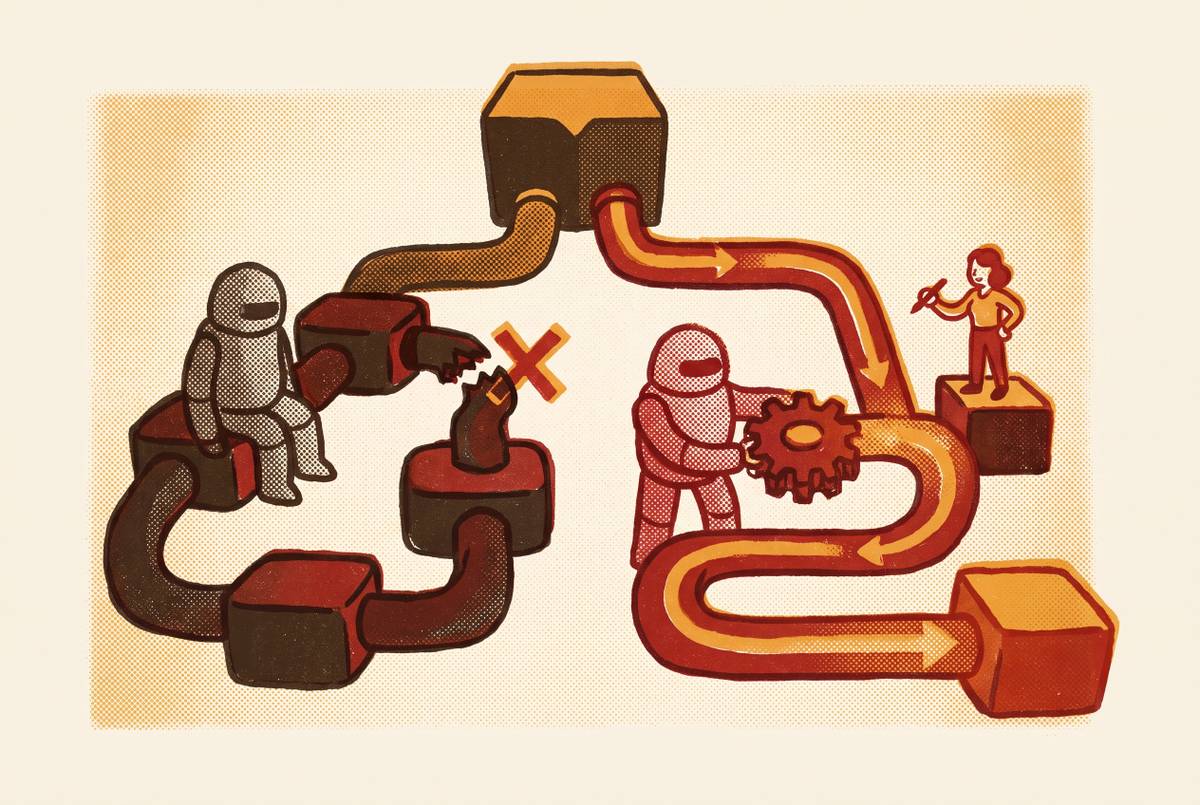
An operation can keep moving without having a coherent process. Staff fill in missing information, sort out records that conflict, and get approvals through people they know, none of which appears in the official workflow. That work hides gaps in how the process is defined. When automation removes or bypasses that human repair work, the gaps become execution problems. Whether the visible steps describe how the work actually gets done must therefore be established before assessing a tool's ability to perform them.
Kognitos's 2026 analysis distinguishes Level 1 success, a working pilot, from Level 2 readiness, which requires scaled, integrated, outcome-measured operation. Confusing the two makes deployment look like operational progress before the business has established what changes downstream. A process can run and still change nothing. That failure is easy to misdiagnose as a technology or data infrastructure problem when the missing element is a defined connection between execution, responsibility, and business outcome.
What should a process audit ask before AI deployment?
The internal logic test asks four questions about a single process. What does the process do? Who owns each step? What does a valid output look like? What happens when an exception occurs? These are not maturity categories or procedural housekeeping. Together, they establish the minimum specification an agent needs to execute reliably.
The first question establishes the process's purpose. The second locates responsibility throughout the work, including handoffs. The third defines what makes the result acceptable, while the fourth establishes what happens outside the expected path. An output cannot be meaningfully defined if nobody can say which exception makes it invalid or who must resolve that exception.
Writing an agent specification exposes whether those answers exist. The specification is a formal process description, so an inability to write it is evidence of unresolved operational logic. The official workflow is often too short. A slide may show five steps while staff also fill in missing fields, reconcile IDs, wait for approvals, and fix systems after the process is supposed to have ended. The test brings those hidden actions into the scope of the process.
The three failure indicators the test consistently surfaces
Tribal ownership, informal exception handling, and undefined output responsibility are disqualifying conditions until resolved. They reinforce one another. When process knowledge exists only in someone's head, the team cannot review or transfer it reliably. The same dependence leaves exception decisions undocumented. Attempting to write an agent specification can expose both problems at once, because the team discovers that it knows who usually handles the work but cannot describe the rules that person follows.
Informal exception handling then turns that knowledge gap into an execution risk. If step three of a five-step process is “check with Sarah,” the automation has no specified decision to execute. It may stop, return an error, or skip the check. A visible stoppage reveals the missing logic, while an unchecked result can reach the next stage without revealing what was omitted. IBM Research's AssetOpsBench benchmark tests complex, multi-step industrial queries because the work includes edge cases that simple task automation does not cover.
Scored leads, flagged anomalies, and maintenance recommendations have no value unless someone in an assigned role acts on them within a set time. Prompt tuning cannot assign that organizational responsibility. Warning signs include a process that no one owns, no agreement on what a successful output looks like, and plans for integrations before the steps are settled. A practical readiness threshold is crossed when a meaningful proportion of automated cases needs manual review in the first weeks, errors repeat across case types, or a second manual process emerges to catch automation errors.
What RPA's history established about encoding incoherent processes
Stanford's ECLAIR research looked at robotic process automation at a hospital and a large B2B enterprise. It found high set-up costs, unreliable initial execution, and burdensome maintenance requiring multiple full-time staff. The B2B case also involved a lengthy gap between kickoff and deployment. The researchers identified the difficulty of encoding tacit human workflow expertise into a rule-based system as the underlying problem.
That history establishes why process specification must precede execution. A bot needs explicit rules for work that people may complete through undocumented judgment and informal exception handling. When those rules are missing, brittleness exposes the process's ambiguity. Adding automation makes deciding what should happen unavoidable, often after substantial implementation work has already begun.
The CASE framework paper from Cornell and AI71 explains why agents raise the stakes further. Classical automation could rely on a DevSecOps toolkit when behavior was enumerable at design time. Agents break that equivalence because their behavior is a stochastic policy over an open action space. Their possible actions are not fully specified in advance. A process must still be coherent, but pre-deployment certification alone cannot control everything an autonomous system may do.
How AI agent deployment is repeating the coherence mistake at higher stakes
The CASE paper places all thirty-five scored public agent deployments in the lowest maturity band of its governance model. It also finds that none of twenty-two ecosystem tools fully covers emergence-layer risks, where agents act on one another in ways that single-agent assurance cannot predict. The gap extends beyond individual task execution. A process that appears manageable in isolation may participate in a larger system whose behavior requires different controls.
The pressure to deploy can obscure that distinction. A majority of executives at companies already piloting agents expect close to half their processes to be redesigned around agents within four years, while only roughly one in five say their processes are prepared today. Placing agents over existing workflows promises faster returns than redesign. But it also gives those agents the unresolved ownership, exception paths, and output definitions already embedded in the work.
The CASE paper finds that 82% of recorded failures of agents in production are multi-layer trajectories. Writer's 2026 enterprise AI survey separately finds that a substantial share of organizations have no formal deployment plan and could not shut down a rogue agent. The CASE paper identifies the central category error as treating agency, shaped by context, memory, and interaction, as automation whose behavior can be enumerated beforehand. Reliable task execution by an agent depends on whether the process was ever coherent enough to execute reliably.
Where the coherence gap is largest in asset-heavy industries — construction scheduling and procurement
A large majority of contractors expect AI to meaningfully affect construction, yet only a small fraction have adapted their workflows for it. Scheduling provides a concrete test of that readiness. A majority of baseline construction schedules fail basic quality benchmarks, so the output an agent would interpret or work from already falls short of the required standard.
This is a failure of the test's third question. If baseline schedules routinely fail quality benchmarks, a valid output has not been established in operational practice at industry scale. Automating work against those baselines can enforce the weak baseline faster and more widely. The distinction is between producing a schedule and producing one that satisfies a defined operational purpose.
The consequences affect whether a data center is ready for energization. The program faces risks in electrical procurement and commissioning, where procurement gates for long-lead equipment must match what factories can deliver. Procurement, scheduling, and commissioning must therefore form a coherent sequence before their handoffs can be automated reliably. AssetOpsBench includes real industrial scenarios involving data center asset management and tests queries crossing sensor telemetry, FMEA records, and work orders. Its domain-specific evaluation reflects the difficulty of work that spans several operational records rather than a single, self-contained task.
What process redesign — rather than process automation — actually requires
The response is to redesign the process. Ownership, exception handling, and output definitions must become part of how the work operates. Shunko and Netessine identify four failure modes when companies automate rather than redesign, including accelerating tasks rather than value, ignoring the unhappy outcome, overlooking the end-to-end flow of work, and optimizing the wrong metric. Faster execution can coexist with all four failures. The corrective task is to define the whole flow and its intended result before optimizing individual activities.
Procter and Gamble followed that sequence in changing its supply chain. OMP's case study describes a cut from thirty-five processes to twenty as part of a touchless, AI-enabled transformation, with full chain ownership taking the place of role handoffs. The number of processes was cut before automation began. Deciding which processes to eliminate required a clear account of their purpose, responsibility, and output.
AssetOpsBench shows why complex asset hierarchies, failure mode libraries, and multi-modal data call for specialized agents working against clearly defined operational semantics. A generalist tool does not provide those definitions. For operations leaders in construction and logistics, the starting point should therefore be a specific, painful process rather than a platform strategy or broad transformation roadmap. Before the first agent is deployed, the work is to make that bounded process coherent enough to specify.
Answering the objection that AI deployment should force process clarity rather than wait for it
The strongest objection is that an agent project can force the clarity an organization has avoided. Attempting to write a specification often reveals ambiguity that earlier audits missed, so requiring complete clarity before any AI work begins could discard a useful diagnostic. That objection has force, but it confuses the catalyst with the precondition. Writing a specification can reveal the problem before an agent goes into production. Discovery during live deployment is more expensive because the process is already running, the agent is acting, and errors are accumulating.
The practical response is to use specification as the audit instrument. The team should resolve the ambiguities it reveals before allowing production execution, rather than treating live operation as the place to settle ownership and exception rules. Kognitos argues that governance designed in from the start is achievable, while retrofitting governance onto probabilistic AI typically fails at the first audit cycle. The same sequencing applies to process coherence. The CASE paper adds that incoherence can propagate between interacting agents in ways single-agent tests do not predict, so deferring the work compounds the risk.
This does not require an indefinite transformation program. A first AI-first process can be live in weeks when it is specific and bounded and the pre-deployment coherence work is rigorous. Long timelines usually mean the team chose the wrong process to start with or put off coherence work until the pressure of production made it harder. The audit is therefore a way to control scope.