Rebuilt-Process DoctrineLong read
The Department Operating Model That Makes AI Agents Redundant or Essential
Agents succeed or fail on a department's structure, not its tools.
· 11 min read
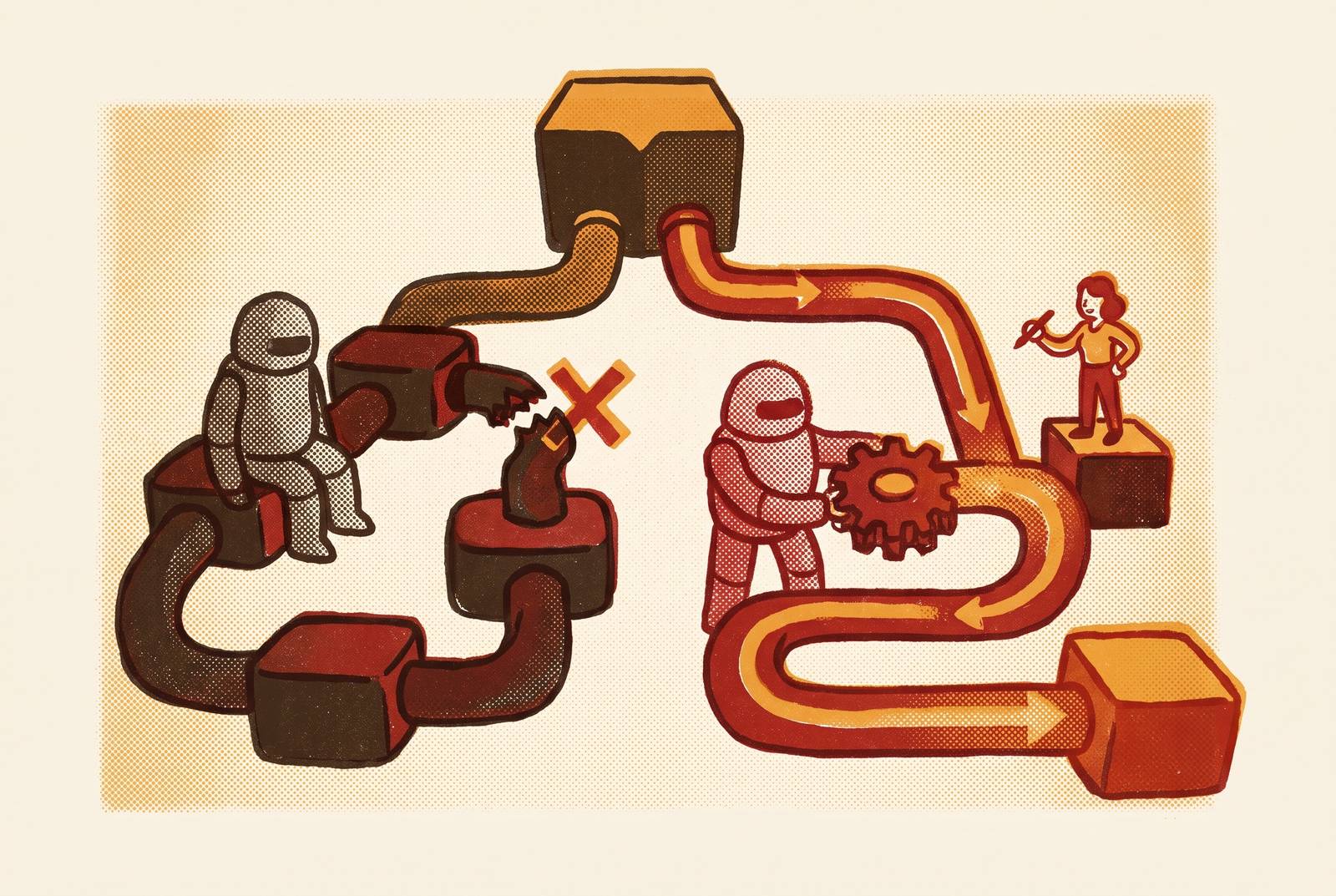
Why operating model structure determines whether AI agents succeed or fail before deployment begins
- Role: Opens the argument by establishing the central claim — agent value or futility is decided at the structural level, not the technology level — and frames the lens the rest of the article will apply.
- The operating model a department runs on determines whether AI agents compound value or expose dysfunction — not the agents themselves, and not the vendor selected.
- The distinction matters because enterprise AI agent adoption is now mainstream: a May 2025 PwC survey found most organizations say AI agents are already being adopted at their companies, yet only a small minority operate them at full production scale — a gap that is structural, not technical.
- Agents differ from rule-based RPA in that they reason through variable inputs, coordinate across systems, and handle exceptions through conditional logic — which is exactly why they depend on a structured environment to function: the reasoning requires inputs that are clean, decisions that are defined, and exception paths that are bounded.
- Note: Open on the distinction between "we deployed agents" and "agents are working" — most enterprises are in the first category. Resist any framing that makes this a technology capability story; the argument is operational and structural throughout.
- The shift from RPA to agentic architectures is happening precisely because legacy automation cannot handle the exception volume in complex operational workflows — but this does not mean agents can handle it automatically; it means the operating model must be built to channel that exception volume correctly.
- Note: Keep this section tight — one to two paragraphs in the article. Its job is to plant the structural question, not survey the agent landscape.
The three structural conditions that make a department agent-ready
- Role: Builds the diagnostic framework the article will apply throughout — names the three conditions an operating model must satisfy before agents can function, grounding them in how agents actually work rather than in abstract best practices.
- An operating model must satisfy three structural conditions for agents to add value: clear decision rights, clean and connected data flows, and defined exception boundaries — and the absence of any one of them is sufficient to make agents either redundant or harmful.
- Decision rights: agents act when they know what a decision looks like and who owns it; where decisions are negotiated informally or resolved through tribal knowledge, an agent cannot distinguish a valid action from a violation.
- In agentic architectures, the LLM acts as the reasoning core while the agent layer executes — but execution requires knowing the scope of authorized action; Fracto's 2026 agentic AI guide frames this as agents needing defined objectives, not step-by-step instructions — which only works when the objectives map to real decision authority in the department.
- Clean data flows: agents integrate with CRM, ERP, ITSM, and procurement systems simultaneously — they do not improve data quality, they depend on it; where data is siloed, inconsistent, or manually maintained, agents amplify the inconsistency at volume.
- Most enterprise agent deployments in 2026 are built around persistent memory and deep system integration; Google Cloud's Gemini at Work 2026 announcement describes agents requiring connection to "personal workflows, systems of record, and enterprise controls" before they can function — the connectivity assumed is what most departments have not built.
- Defined exception boundaries: agents escalate to humans when a situation falls outside operating boundaries — which requires those boundaries to exist and be documented; where exceptions are handled ad hoc, agents either escalate everything (becoming expensive noise) or handle nothing (becoming invisible overhead).
- Note: This is the conceptual core of the article — give each condition a concrete operational description, not a list of features. The writer should be able to make a practitioner feel the absence of each condition before moving on.
- The strongest objection is that agents can be trained to learn the informal structure of a department over time — the answer is that agents trained on improvised coordination learn to replicate it at scale, which is precisely the failure mode the article is arguing against.
How improvised coordination and tribal knowledge actively break agent deployments
- Role: Shifts from the structural conditions that enable agents to the specific failure mechanisms that emerge when those conditions are absent — moves the argument from "what is needed" to "what actually goes wrong."
- The operating patterns most common in departments — informal escalation, undocumented exceptions, decisions held in individuals' heads — are not neutral gaps that agents work around; they are the precise inputs agents cannot process and the precise conditions that produce production failures.
- Five structural failure modes recur across industries: governance gaps (agents act outside policy), transparency gaps (reviewers cannot reconstruct agent actions), coordination gaps (agents in multi-agent systems drift out of step), safety gaps (untrusted content contaminates trusted reasoning), and plateaued improvement (deployments stop improving despite model upgrades).
- Each failure mode maps directly to an absent structural condition: governance gaps map to undefined decision rights; transparency and coordination gaps map to broken data flows; safety and plateau gaps map to undefined exception boundaries.
- The pilot-to-production failure rate is the clearest empirical signal: agents that perform in demo conditions fail in production because demo conditions are controlled versions of the structural environment that real departments do not provide.
- Hallucinated tool calls, repetitive loops, silent failures that appear as successes, and inconsistent results on complex tasks are production realities once volume scales — they are not technology bugs, they are structural mismatch becoming visible at scale.
- In multi-agent systems — which are the dominant architecture for complex operational workflows — a failure in one agent propagates: a procurement agent failure flows to production scheduling, which flows to logistics, producing supply chain disruptions that take weeks to unwind.
- This is the compounding risk that makes structural readiness non-negotiable: a single broken coordination pattern, amplified across three agents, can produce cascading failures that no monitoring layer catches in time.
- Note: The writer should make this section feel like a field autopsy, not a warning list. Each failure mode should read as a recognizable operational event, not an abstract category.
Construction as the sharpest case: where field evidence diverges from declared plans
- Role: Moves from the general framework to the most instructive industry case — construction — where the gap between declared operating model and actual coordination reality is largest, making agent failure most predictable and most costly.
- Construction is the clearest test of the structural argument because it is an industry with no shortage of scheduling tools, dashboards, and AI-generated risk scores — and yet critical work still fails to start because the underlying coordination model is improvised, not structured.
- The construction data problem is not a data volume problem; it is a data quality and governance problem: most captured data goes unused, and AI scheduling trials fail not because the models are wrong but because the schedule data fed to those models is too poor to support inference.
- P6 schedules and similar planning tools record intent, not achievability — real schedule risk lives in procurement lead times, coordination dependencies, and commissioning sequences that are never captured in the schedule data an agent would read.
- Change orders on design-build jobs that lock design packages at an early completion stage run at a different rate than GC jobs that develop design in parallel — the operating model of how design and construction are sequenced determines the exception volume agents would face.
- Energization readiness is a specific, repeatable failure mode where declared schedules diverge from field reality: utility connection queues run multi-year in many regions, making energization dates soft targets that no scheduling agent can accelerate.
- In Ireland, grid energization alone adds roughly ten months to the back end of a data center programme — longer than the entire MEP fit-out phase; in Virginia, roughly six months — the concrete and steel are not the constraint, the coordination with external systems that agents cannot control is.
- Note: This section should feel grounded in field observation, not technology review. The energization example is especially strong — use it to make the point that agents cannot resolve coordination failures with parties outside the department's control, which is what most real schedule risk consists of.
Manufacturing and logistics cases: where structured operating models let agents compound value
- Role: Provides the affirmative side of the argument — shows what agents achieve when the structural conditions are present — establishing that the argument is not against agents but for the operating model that makes them work.
- The manufacturing and logistics deployments that produce documented, large-scale results share a common structural characteristic: the operating model was redesigned around agents before deployment, not retrofitted after.
- Tata Steel's deployment of more than 300 specialized AI agents across nine months to enhance manufacturing safety, optimize predictive supply chains, and cut customer complaint turnaround times by 50% succeeded because each agent operated on a bounded, well-defined process with clear data inputs and escalation paths — the structural conditions were built into the deployment design.
- In logistics, General Mills runs an AI-driven supply chain optimization system that evaluates thousands of daily shipments, generating optimized recommendations for routing, timing, and carrier selection, with humans accepting or overriding the majority of suggestions — and flags only genuine exceptions for human review; the system works because "genuine exception" is a defined category, not an improvised judgment.
- DHL's AI transformation reduced forecast errors, increased warehouse productivity substantially, and achieved near-perfect order accuracy — outcomes that depend on clean, connected data flows across the supply chain, not on agent capability alone.
- A regional distribution operator that deployed AI route optimization reduced planning time substantially and reduced delivery failure rates materially — the scale is smaller but the structural pattern is identical: bounded process, clean inputs, defined exception handling.
- IDC's finding that a substantial share of manufacturers with production scheduling systems in place will upgrade with AI-driven capabilities reflects a shift from scheduling as a record-keeping function to scheduling as an active decision system — which only works if the decision rights and data flows underneath the schedule are already structured.
- Note: The writer should use the contrast between this section and the construction section deliberately — the difference is not industry, it is operating model structure. Avoid making this section feel like a technology showcase; the named organizations matter because of what their operating model enabled, not because of the agent platform they used.
- The strongest objection is that manufacturing and logistics are structurally simpler than construction — the answer is that they were not always; the structured operating models in these cases were built, not inherited.
How P&G's process redesign before deployment illustrates the right sequence
- Role: Provides a single, named case study that demonstrates the correct sequence — operating model redesign first, agent deployment second — and grounds the article's prescription in a documented organizational decision.
- Eliminating a set of processes before deploying agents meant agents operated on a clean, reduced process surface — the exception volume was structurally lower, the decision rights were clearer, and the data flows were fewer and more defined.
- A national retailer with many stores that deployed AI-powered demand forecasting and inventory optimization attributed its results to three factors: starting with a focused, high-value use case; pairing AI systems with experienced planners; and investing in change management so planners trusted AI recommendations — each factor is a structural condition, not a technical one.
- Note: This section should land as a concrete proof point for the article's prescription, not as a case study summary. The writer should draw the explicit connection between what P&G did before deployment and the three structural conditions named earlier.
- The sequence matters: departments that attempt to redesign processes and deploy agents simultaneously — or that deploy agents hoping they will surface the process redesign needed — consistently produce the failure modes named in the earlier section.
The practical diagnostic: how an operations leader evaluates whether a department's operating model is agent-ready
- Role: Converts the structural argument into a usable practitioner tool — the article's payoff — giving operations leaders a concrete way to apply the three structural conditions before committing to agent deployment.
- An operations leader can evaluate agent-readiness before deployment by asking three diagnostic questions, each mapped to one of the structural conditions: Where do decisions actually get made, and is that documented? Where does data break down, and who owns fixing it? What happens when the process fails, and is that path defined or improvised?
- Decision rights diagnostic: ask the department to show — not describe — how a routine exception is resolved; if the answer involves calling a specific person, using a group chat, or "it depends," the decision right is not structured enough for agents to operate on.
- A process audit — walking the actual steps of a process rather than reading a documented version — surfaces this faster than any survey or interview because it reveals the improvised coordination that documentation never captures.
- Data flow diagnostic: ask where the data that drives the process lives, how it gets from source to decision, and what happens when it is wrong; if the answer involves manual steps, spreadsheet handoffs, or "someone checks it," the data flow is not clean enough for agent integration.
- Vellum's 2026 platform guide notes that enterprise-grade agent environments require complete audit trails for every action, prompt, and output — a requirement that reveals data flow gaps immediately, because most departments cannot currently produce that trail.
- Exception boundary diagnostic: ask what the process does when something falls outside normal parameters — if the answer is "we figure it out," the exception boundary is undefined; agents deployed into this environment will either escalate everything or decide nothing.
- The right starting point for any department is one specific, painful process that already has cleaner structure than the rest — not a platform strategy or a broad transformation roadmap; deploying agents on the best-structured process first builds the data and governance infrastructure that other processes can then inherit.
- Note: This section should read as a practitioner's checklist, not a consultant's framework. The questions should feel immediately applicable — an operations leader reading this should be able to run the diagnostic in a working session, not a six-month assessment.
- The governing principle is that a department that cannot answer these three diagnostic questions clearly is not ready for agents — and deploying agents before answering them does not answer them; it makes the absence of answers a production problem at scale.
- Note: Close this section — and the article — on the process audit as the honest starting point: show us how the process actually runs and where it hurts, and the structural readiness becomes visible immediately. This positions a rigorous, field-grounded approach as the alternative to vendor-led deployment decisions.
Filed underRebuilt-Process Doctrine
More in Rebuilt-Process Doctrine

The Workflow Integrity Test That Tells a Construction Operation What to Preserve Before a Platform Decision Is Made
Dmitri Vashenko

The Engagement Model That Puts Process Diagnosis Before Scope in Construction and Logistics Advisory
Renata Osei-Kwame

The Internal Logic Test That Tells an Operation Whether a Process Has Ever Been Coherent Enough to Automate
Solange Mirambel